English
 Español
Three rolls can carry the same “fleece” label and still behave like three different fabrics. One may feel dense and smooth, another curly and deep, and a third stretchy with a soft brushed back. The short answer is that fleece is not one fiber or one weave. It is a family of fabrics defined by a knitted base, a raised surface, and a set of finishing choices that determine warmth, hand feel, durability, and price. For a buyer, the useful question is not “Is this fleece?” but “Which fleece construction fits this garment, this season, and this target cost?”
That distinction matters early in development. A microfleece lining chosen for a lightweight jacket will not deliver the loft of a sherpa trim. A brushed-back sweatshirt fleece can feel perfect in a hoodie but may be too heavy and too warm for a travel blanket. A bonded fleece may solve wind resistance and shape retention, but it also brings delamination risk and a higher unit cost. The practical path is to compare the fabric by base knit, fiber blend, pile height, brushing method, finishing route, and the performance test that matters for the final product.
This guide compares the main types of fleece fabrics used in apparel, accessories, and home textiles. It focuses on what each type is, where it fits, what can go wrong in bulk production, and what to specify in a sample request or purchase order. Typical weight ranges are included as starting points; they are not universal standards. A mill’s 280 gsm fleece may feel heavier than another mill’s 320 gsm because stitch density, yarn bulk, brushing, and relaxation all change the hand feel.
Fleece Is a Construction, Not a Single Fiber
In apparel sourcing, “fleece” most often refers to a weft-knitted fabric with a raised surface. The base may be polyester, cotton, rayon blends, acrylic, or a mixture. The warmth comes from trapped air in the pile and from the knit structure, not from a single raw material. A dense microfleece and a high-loft sherpa can both be polyester, but they are not interchangeable. Their yarn size, stitch length, pile height, brushing intensity, and finishing route create different products.
The word also appears in other contexts. “Wool fleece” can describe the natural coat of a sheep or a wool-rich fabric with a soft, brushed surface. “Fleece-back” can describe a sweatshirt knit with a brushed inner side. “Polar fleece” usually means a synthetic, double-sided brushed knit. “Sherpa” describes a deep, curly pile effect rather than a fiber. “Bonded fleece” means the fleece has been joined to another material, such as a woven shell, film, or knit, to create a composite. These distinctions are not academic; they affect care labels, performance claims, test methods, and the supplier you should approach.
A useful way to compare the family is to look at the surface, the base structure, the approximate weight band, and the main sourcing risk. The table below summarizes the common commercial types.
| Type | Base construction and fiber | Surface character | Typical weight band | Common uses | Sourcing watchpoint |
|---|---|---|---|---|---|
| Polar fleece | Polyester circular knit, brushed on one or both sides | Dense, soft, low to medium nap | 180–400 gsm | Midlayers, jackets, blankets, casual tops | Pilling, static, pile crush, shade variation |
| Microfleece | Fine-denier polyester knit, lightly brushed | Smooth, dense, thin, low bulk | 100–250 gsm | Linings, base layers, babywear, travel accessories | Hand feel varies with filament quality; check anti-pill finish |
| Sherpa | Polyester or blends, high pile with curled fibers | Deep, curly, sheepskin-like | 220–450 gsm | Outerwear linings, hoods, homewear, trims | Shedding, bulk, weight control, backing stability |
| Berber | Heavier knit with a nubby, textured surface | Textured, wool-like, loftier | 250–450 gsm | Jackets, blankets, home textiles | Needle damage, shade variation, surface uniformity |
| Anti-pill fleece | Polar or microfleece with modified fiber or finish | Smoother after abrasion; controlled fuzz | 160–350 gsm | High-wear garments, uniforms, childrenswear | Test method and rating; finish may change hand |
| Sweatshirt fleece | Cotton or cotton-poly knit with brushed back | Smooth face, soft brushed back | 240–400 gsm | Hoodies, joggers, crewnecks, kidswear | Shrinkage, colorfastness, torque, back-brushing quality |
| French terry | Cotton or blend loopback knit; may be brushed | Looped or softly brushed back | 180–350 gsm | Sweatshirts, casualwear, lightweight joggers | Loop uniformity, stretch recovery, surface skew |
| Bonded fleece | Fleece bonded to shell, film, or knit | Engineered face and back; variable hand | 250–600 gsm | Softshells, outerwear, technical jackets | Delamination, adhesive strike-through, stiffness, shrinkage mismatch |
The table shows why a fleece brief needs more than a color and a weight. Two fabrics at 280 gsm can differ in warmth, drape, stretch, and pilling because one is a tight microfleece and the other is a high-loft sherpa. For product development, describe the end use first, then ask for the construction that meets it. That sequence keeps the mill from offering a fabric that looks correct in a swatch but fails in wear.
Polar Fleece: The Reference Point
Polar fleece is the type most buyers picture when they hear the word. It is usually a circular-knit polyester fabric brushed on one or both sides to create a soft, airy surface. The brushing breaks some fibers and lifts them into a pile, which traps air and gives the fabric its warmth-to-weight ratio. A good polar fleece feels dense but not stiff, recovers from compression, and has a surface that does not shed heavily when rubbed.
The construction is flexible. A lightweight version around 180–220 gsm can work as a liner or a light pullover. A mid-weight version around 250–320 gsm is common for jackets, vests, and blankets. A heavier version above 350 gsm can suit outerwear or cold-weather accessories, but it may become bulky in garment assembly. The buyer should confirm the nominal weight, tolerance, width, shrinkage, and pilling performance rather than relying on the “polar fleece” name alone.
Polar fleece is hydrophobic and quick-drying compared with cotton, but it is not automatically windproof or waterproof. It also can generate static and attract lint. Anti-pill finishing and fiber selection can reduce fuzzing, but they may change the hand from soft and lofty to smoother and denser. For high-wear products, ask for a pilling test result after a defined number of cycles, and check the result against the garment’s expected life. A fleece that looks clean after ten wears may still pill in the wash after twenty.
 YZK-110237 Polyester Fleece Fabric 320–330 g/m²Mid-weight 100% polyester fleece at 320–330 g/m² and 155 cm width, useful for comparing hand-feel, drape, and thickness against target garments.View Product →
For teams sampling a mid-weight brushed fleece, a representative fleece product card is useful as a hand-feel reference. Compare it against the target garment’s required drape and thickness, not just the swatch color. A fleece that is too dense can make a hoodie feel rigid; one that is too lofty can add bulk at the seams and increase cut waste.
Microfleece: Fine Denier, Dense Surface, Low Bulk
Microfleece uses finer filaments than standard polar fleece, which creates a denser, smoother surface with less visible nap. It is often lighter, around 100–250 gsm, and is chosen when the product needs warmth without bulk. Common uses include jacket linings, travel blankets, neck gaiters, babywear, and lightweight base layers. The fine surface can also accept printing and embossing more cleanly than a deep pile, although the design still needs to be tested for sharpness and wash durability.
Microfleece is not simply “thin polar fleece.” The finer filaments can produce a different balance of softness, durability, and cost. A low-quality microfleece may feel smooth in the roll but develop fuzz quickly after abrasion. A better version uses consistent filament quality, controlled brushing, and an anti-pill finish. The buyer should check the fabric under low-angle light for surface uniformity, then rub a sample against a standard abradant to see how quickly loose fibers appear.
Because microfleece is often used next to the skin or as a lining, consider comfort factors beyond warmth. Check air permeability if the garment needs breathability, and check moisture management if the wearer will sweat. A dense microfleece can feel clammy when used as an active layer, even though it is lightweight. For linings, ask whether the supplier can provide a calmer surface that slides easily over other layers without creating friction.
Sherpa and Berber: Texture With Higher Loft
Sherpa is a pile effect designed to resemble sheepskin. It usually has a deeper, curled surface and a higher loft than polar fleece. The base may be polyester, acrylic, or a blend, and the pile can be knitted or created through brushing and finishing. Sherpa is often used as a lining in jackets, a hood lining, a trim, or a standalone homewear fabric. It delivers visual warmth as well as physical warmth, which is why it appears in fashion outerwear as much as in performance garments.
The sourcing risk with sherpa is surface stability. A deep pile can shed, mat, or crush during packing and transport. The backing must hold the pile securely, and the garment design must allow for the extra thickness at seams, hems, and closures. If the sherpa is used as a lining, check the bonding or attachment method: a poorly stabilized pile can distort the outer shell after washing. For a hood lining, the pile should feel soft against the face but not so deep that it interferes with the zipper or drawcord channel.
 YZK-110030-1 Custom Sherpa Fleece Fabric100% polyester sherpa at 230 g/m² and 175 cm width, relevant for checking pile height, backing, and shedding in apparel fabric sourcing.View Product →
A sherpa card should be evaluated for pile height, density, backing, and shedding. Press the pile flat with your hand and see how quickly it recovers. Shake it over a dark surface to check loose fiber. If the garment will be washed frequently, ask for a wash test that includes dimensional change and surface appearance. Sherpa that looks luxurious in a sample may become patchy after repeated laundering if the pile is not properly anchored.
Berber is related but distinct. It has a nubby, textured surface that reads more like wool or a heavier knit. It can be used in jackets, blankets, and home textiles where a rustic or textured look is desired. Berber often carries more visual texture than polar fleece, so shade variation and needle lines are more visible. Inspect the fabric on the roll and after cutting; a surface that looks uniform in flat form can show streaks when the garment panel is stretched or sewn.
Anti-Pill Fleece and the Finishing Effect
Pilling is one of the most common complaints in fleece garments. It happens when loose fibers on the surface entangle into small balls under abrasion. The problem is not solved by the word “anti-pill” alone. Fiber tenacity, staple length, yarn twist, stitch density, brushing intensity, and finishing all affect the result. A tight knit with well-anchored fibers may resist pilling better than a loose, lofty knit, but it may also feel less soft.
Buyers should ask for a specific test method and a rating, not a general claim. Depending on the market and the lab, pilling may be assessed by random tumble pilling, Martindale abrasion, or another agreed method. Ask how many cycles were run, what the acceptance rating is, and whether the test was done on the greige fabric, the finished fabric, or the washed garment. A supplier may pass a lab test on a flat swatch while the sewn garment fails at high-friction areas such as underarm seams, cuffs, and collar edges.
Anti-pill finishing can improve surface appearance, but it can also reduce the soft, fuzzy hand that consumers expect from fleece. The right balance depends on the product. A uniform for daily wear may prioritize a clean surface after twenty washes. A fashion hoodie may accept a slightly softer, fuzzier hand if the customer cares more about comfort than long-term appearance. State the priority in the brief so the mill does not optimize for the wrong result.
Sweatshirt Fleece, French Terry, and Brushed-Back Knits
Not every fabric called fleece is a high-pile synthetic. In casualwear, “sweatshirt fleece” usually means a circular-knit cotton or cotton-poly fabric with a smooth face and a brushed back. It is the fabric behind many hoodies, crewnecks, and joggers. The brushed inner surface feels soft against the skin, while the outer surface provides a clean canvas for printing, embroidery, or garment dyeing. The weight often sits around 240–400 gsm, depending on the season and the intended drape.
French terry is close in use but different in construction. It has a loopback reverse rather than a fully brushed back, although some versions are lightly brushed. French terry tends to be more breathable and more drapey than heavy sweatshirt fleece. It is common in lightweight sweatshirts, casual tops, and joggers. The loopback can absorb moisture and add bulk, so the buyer should consider the garment’s climate and fit. A summer French terry at 180–220 gsm behaves very differently from a winter sweatshirt fleece at 380 gsm.
For these fabrics, stretch recovery and torque matter as much as warmth. A sweatshirt fleece that grows after washing or spirals after cutting can create fit problems in bulk. Ask for shrinkage by direction, torque, and recovery after repeated stretching. If elastane is present, confirm the percentage and the heat-setting route. Knitted fabric elasticity depends on loop structure, yarn properties, and finishing, so two fabrics with the same fiber content can behave differently in wear.
Buyers sometimes use “fleece” loosely when the correct term is “brushed-back sweatshirt knit” or “French terry.” That looseness creates avoidable sampling errors. If the design needs a smooth face for a large print, a deep-pile sherpa is the wrong starting point. If the design needs a soft inner surface for a hoodie, a tight microfleece may feel too synthetic and slippery. Name the construction, not just the hand feel.
Bonded Fleece: When the Backing Becomes the Performance Layer
Bonded fleece is a composite. A fleece fabric is joined to another material, such as a woven shell, a knit, a film, or a foam, using adhesive, flame bonding, or another lamination route. The goal may be wind resistance, shape retention, added warmth, a softer hand, or a combination of those effects. In outerwear, a fleece back can provide comfort next to the body while the face fabric handles abrasion and weather. In accessories, bonding can stabilize a deep pile and make it easier to cut and sew.
The performance of a bonded fleece depends on the whole assembly, not just the fleece side. Adhesive choice, coating weight, bonding temperature, and the shrinkage behavior of each layer affect the final product. A common failure is delamination after washing or dry cleaning. Another is adhesive strike-through, which makes the face fabric stiff or shiny. A third is differential shrinkage, where one layer relaxes more than the other and the composite curls or bubbles.
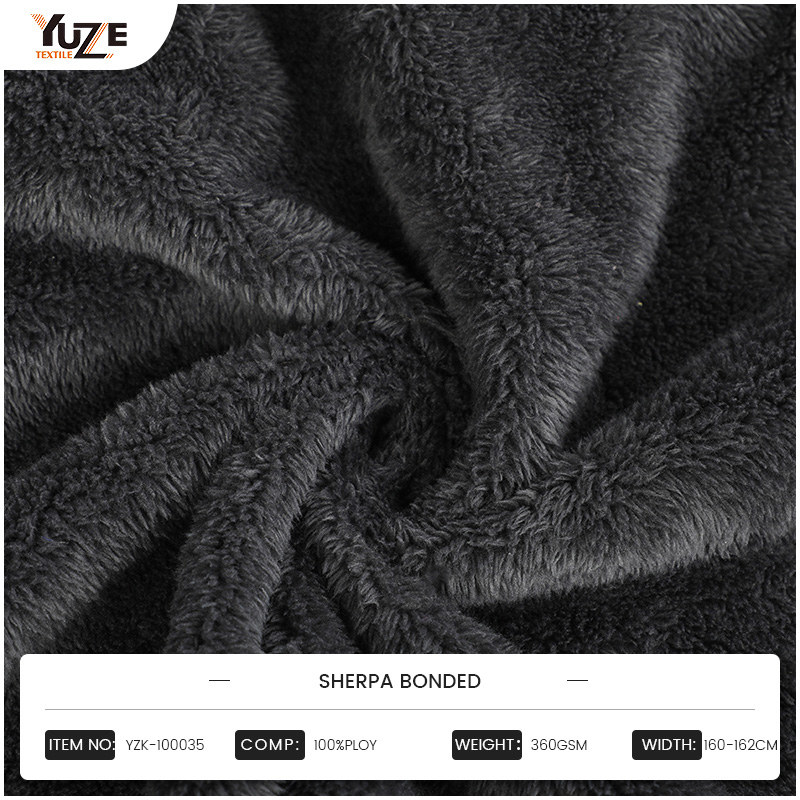 YZK-100035 Bonded Sherpa Fabric 360 GSM100% polyester bonded fabric at 360 GSM and 160–162 cm width, relevant for reviewing lamination stability, edge bonding, and wash performance before garment production.View Product →
For a bonded sherpa or fleece product, ask for a wash test and a dry-clean test if relevant, plus a peel-strength result and a hand-feel assessment after conditioning. Check the bond at the edges, not only in the center of the sample. The cut edge is where delamination often starts. If the garment will be garment-washed or tumble-dried, confirm that the adhesive system can survive that process. Bonded fabrics can be excellent problem solvers, but they need a clear performance brief and a supplier who controls the lamination step.
Specialty Fleece: Coral, Acrylic, Velvet, Jacquard, Printed, and Embossed
Beyond the core types, the fleece family includes several specialized surfaces. Coral fleece is a fine-denier, open-pile fabric with a very soft hand. It is common in homewear, blankets, baby products, and plush accessories. Acrylic fleece can offer warmth and a soft, wool-like hand, but moisture management and pilling behavior need to be checked against the end use. Velvet fleece, sometimes described as a cut-pile or sheared fleece, has a denser, smoother surface with a directional nap. It can work in fashion tops, dresses, and costume pieces where drape and sheen matter.
Jacquard fleece uses a patterned knit structure rather than a surface print. The design is built into the fabric, which can give a richer look and avoids some print registration issues. Printed fleece uses a print on the surface; the pile can soften the print edges, so the buyer should check sharpness and wash fastness. Embossed fleece uses heat and pressure to create a raised or recessed pattern. The effect can be subtle or dramatic, but it may flatten the pile and change the hand. Always test abrasion and washing on the embossed area, not only on the flat ground.
These specialty types are often where design and sourcing meet. A jacquard or embossed fleece can carry a seasonal story without adding a lining or a print step. A coral or velvet fleece can signal comfort or luxury in a homewear collection. The sourcing risk is that the visual effect may hide a performance weakness. A deep emboss can reduce warmth; a print can stiffen a soft pile; a jacquard can create longer floats that snag. Review the fabric in the intended garment silhouette, not only as a flat swatch.
Our knitted fleece range includes brushed, bonded, pile, and specialty surfaces, which is useful when a single collection needs several fleece handles across jackets, hoodies, and accessories. The key is to compare them under the same lighting, after the same wash, and in the same garment construction.
How to Compare Fleece Specifications
A fleece specification should be written so that two suppliers can quote the same thing. “Soft polyester fleece, 300 gsm” is not enough. It leaves the knit structure, pile side, brushing, shrinkage, pilling, and colorfastness open to interpretation. The following points are a practical checklist for sampling and bulk approval.
- Fiber content and percentage, including any elastane, rayon, acrylic, or recycled content.
- Knit structure: single knit, double knit, loopback, jacquard, or bonded composite.
- Pile side: one side, both sides, face brushed, back brushed, or unbuffed.
- Nominal weight in gsm and an agreed tolerance, such as plus or minus five percent.
- Width in centimeters or inches, plus a tolerance and a note on selvedge condition.
- Pilling test method, cycle count, and minimum rating.
- Shrinkage by length and width after the agreed wash or care cycle.
- Colorfastness to washing, rubbing, perspiration, and light where relevant.
- Surface appearance after wash: pile crush, fuzzing, matting, and shade change.
- Stretch and recovery if the fabric contains elastane or is used in fitted garments.
- Bond strength and delamination resistance for bonded fleece.
- Care instructions, label claims, and any restricted substance requirement for the target market.
Ask for the test report to identify the sample stage: greige, finished, washed, or after a simulated care cycle. A result on an unwashed lab swatch can be misleading for a garment that will be laundered repeatedly. If the product is for childrenswear, confirm the relevant safety and chemical requirements before bulk, not after the fabric is already in thecutting room.
Matching Fleece Type to End Use
The fastest way to narrow the choice is to start with the garment’s job. A fleece for a hiking midlayer has different priorities from a fleece for a fashion hoodie or a baby blanket. The list below is a practical starting point for development discussions.
- Outdoor midlayers: polar fleece or grid fleece with controlled pilling, good warmth-to-weight, and a stable hand after packing.
- Jacket linings: microfleece or lightweight polar fleece with a smooth surface, low bulk, and good abrasion resistance.
- Hoodies and joggers: sweatshirt fleece or French terry with matching shrinkage, torque control, and a soft brushed back.
- Fashion outerwear: sherpa, berber, bonded fleece, or embossed fleece where texture and silhouette matter as much as warmth.
- Homewear and sleepwear: coral fleece, soft polar fleece, or acrylic blends with a gentle hand and reliable wash performance.
- Baby and childrenswear: microfleece or soft brushed cotton blends with confirmed chemical safety, low pilling, and comfortable breathability.
- Blankets and throws: heavier polar fleece, sherpa, or berber with good pile recovery and colorfastness.
- Performance softshells: bonded fleece with tested peel strength, wind resistance, and care-cycle durability.
- Costume and fashion trims: velvet fleece, printed fleece, metallic-effect fleece, or embossed pile with a visual finish that survives handling.
This mapping is not a rulebook. A fashion brand may choose a technical bonded fleece for a tailored jacket, while an outdoor brand may choose a lightweight French terry for a travel layer. The point is to state the primary use and the secondary expectation. If warmth is primary, specify loft and air permeability. If appearance is primary, specify surface uniformity and color. If durability is primary, specify pilling, abrasion, and dimensional stability. A supplier can then recommend the right construction instead of offering the widest available roll.
Sourcing, Sampling, and Quality Control
Fleece is a forgiving fabric in the sample stage and a demanding fabric in bulk. The surface can hide small yarn faults, but it can also show shade bands, needle lines, and brushing marks under warehouse lighting. A buyer should review the fabric in the roll, after cutting, and after sewing. Some defects only appear when the fabric is relaxed or when a seam pulls the pile in a different direction.
At YUZE TEXTILE, the sourcing discussion usually starts with the end use, the target weight, the fiber preference, and the performance standard. As a fabric manufacturer and exporter based near the Shaoxing Textile City market, we work across woven and knitted constructions, including fleece, French terry, bonded fabrics, and post-process finishes. Our design team can help translate a hand-feel reference into a workable construction, and we offer free samples and free analysis so that buyers can evaluate the fabric before committing to bulk. Every piece is inspected before packing according to the agreed standard.
For fleece, the most common bulk risks are pilling, shade variation, width loss, shrinkage, pile crush, and bonding failure. A pre-production sample should be washed and evaluated as a sewn garment, not only as a flat swatch. Check the cuffs, collar, pocket edges, and underarm areas, where abrasion and seam bulk are highest. If the fabric is printed or embossed, check the pattern alignment and the surface after wash. If the fabric is bonded, check the cut edge and the bond strength after conditioning.
Sampling should also confirm the cutting behavior. A deep sherpa may require a different cutting method or extra cleanup than a tight microfleece. A bonded fleece may need a specific needle and seam construction to avoid delamination. A brushed-back sweatshirt fleece may shed lint in the cutting room, which can affect the finished garment’s appearance. These are not minor details; they influence yield, labor, and the final cost.
Price, MOQ, and Development Trade-offs
Fleece pricing is driven by more than weight. Fiber type, yarn quality, machine gauge, brushing passes, anti-pill finishing, color method, print complexity, embossing, and bonding all change the cost. A 300 gsm polar fleece made from standard polyester can be competitive, while a fine-denier microfleece with a tested anti-pill finish may cost more. A bonded sherpa adds the cost of the second material, the adhesive, the lamination process, and the testing. A printed fleece adds artwork preparation, print trials, and color approval.
MOQ follows the same logic. Stock colors and greige qualities may have lower minimums than custom colors, jacquard structures, embossed patterns, or bonded composites. Buyers should separate the “must-have” performance from the “nice-to-have” appearance. If the garment needs a specific pilling rating, that requirement should be fixed early. If the shade can move slightly within an approved standard, the supplier may have more flexibility. Clear priorities reduce the risk of paying for a premium feature that the customer will not notice.
There is also a development cost in chasing an unrealistic hand feel. A very soft, very lofty fleece may pill more easily. A very smooth, very durable fleece may feel flatter. A very lightweight fleece may not have enough body for a structured jacket. The right brief acknowledges these trade-offs and states which one matters most. That is more useful than asking for “the softest fleece at the lowest price.”
Care, Labeling, and Consumer Expectations
Fleece care instructions should match the actual fiber and construction. A polyester polar fleece generally tolerates machine washing, but high heat can crush the pile and accelerate pilling. A cotton sweatshirt fleece may shrink more and may need a lower drying temperature. A bonded fleece may have a care restriction because of the adhesive or the second layer. A sherpa may need a gentle cycle and air drying to preserve the pile.
Labels should tell the consumer what to expect without overpromising. “Anti-pill” is a performance claim that should be supported by a test, not a general description. “Windproof” should not appear on a standard polar fleece unless the fabric has been engineered or bonded for that property. “Warm” is subjective; a good label communicates the fabric’s care and fiber content rather than making an absolute thermal claim. If the product uses recycled polyester, confirm the traceability and the permitted claim language for the target market.
Consumers often judge fleece by the first touch, but they remember it by how it looks after several washes. Pilling, matting, and color fade are the usual reasons a fleece garment loses its premium feel. A slightly denser fabric with a tested finish may be a better commercial choice than a very soft fabric that looks worn after a month. That is a product decision, not only a fabric decision.
Sustainability and Fiber Choice
Fleece is often made from synthetic fibers, so sustainability questions tend to focus on recycled content, traceability, and microfiber shedding. Recycled polyester can reduce reliance on virgin fossil feedstock, but the buyer should confirm the source, the certification chain, and the performance of the recycled yarn. A recycled fleece still needs to pass pilling, shrinkage, and colorfastness tests. The “recycled” label does not replace the fabric specification.
Mono-material construction can make recycling easier, but a bonded fleece with multiple layers and adhesives may be harder to separate. If circularity is a goal, discuss the bonding method and the possibility of mechanical recycling with the supplier. For high-shedding pile fabrics, a tighter surface, a shorter pile, or a different brushing route may reduce loose fiber release, but it can also change the hand. There is no universal best answer; the right choice depends on the product’s life, care, and end-of-use plan.
Buyers should also avoid making vague environmental claims. “Eco-friendly fleece” is not a specification. “Made with 50 percent recycled polyester, verified by a traceability certificate, with a pilling rating of four after the agreed wash” is a specification. The more precise the brief, the easier it is to compare suppliers and to support the claim with evidence.
What to Put in a Fleece RFQ
A good fleece RFQ gives the supplier enough information to propose a construction, not just a price. Start with the end use and the garment type. Then state the fiber content or preferred fiber family, the knit structure, the pile side, the nominal weight, the width, and the color standard. Add the performance tests that matter for the market: pilling, shrinkage, colorfastness, stretch recovery, bond strength, and any restricted substance requirement. State the sample quantity, the target delivery date, and the expected order quantity so the supplier can advise on MOQ and lead time.
Include a hand-feel reference if possible. A physical swatch is better than a photo, and a washed swatch is better than a greige swatch. For bonded fleece, include the face fabric and the intended care cycle. For sherpa, state the pile height and whether shedding will be checked. For sweatshirt fleece, state the shrinkage and torque limits. For printed or embossed fleece, provide artwork or a reference and ask for a strike-off before bulk.
The final decision should be based on the fabric in the garment, after the agreed wash, with the required tests attached. That is the practical difference between buying a fleece swatch and sourcing a fleece fabric. The family is broad, but the specification can be precise. Once the construction, weight, surface, and performance standard are clear, the supplier conversation becomes much more productive and the bulk risk becomes much easier to manage.