.png)
 English
 Español
When a garment buyer opens a fabric specification sheet and sees a line that reads “T/R twill, 240 gsm,” the word “twill” can seem like another vague textile term. It is not the name of a fiber, and it does not refer to a specific yarn. Twill describes how the warp and weft yarns are interlaced. The result is a fabric with visible diagonal ribs that run across the surface. This article explains what twill means, how the weave works, which properties it delivers, and what a buyer should check before ordering bulk production.
What Does Twill Mean?
Twill is one of the three fundamental weaving systems used in textiles, alongside plain weave and satin weave. In a twill weave, each weft thread passes over one or more warp threads and then under two or more warp threads. The interlacing point shifts by one warp yarn with each pick, creating a diagonal line that runs from the lower left to the upper right. If you run a finger across the surface, you can feel that diagonal ridge.
The structure is commonly expressed as a fraction, such as 2/1, 2/2, or 3/1. The first number counts how many warp threads a weft thread floats over. The second number counts how many warp threads it passes under. In a 2/2 twill, the weft passes over two and under two, producing a balanced, reversible fabric. In a 3/1 twill, the weft floats over three warp ends and under one, creating a fabric with more warp yarns visible on the face. Denim is the most famous 3/1 twill.
The diagonal lines can be angled in either direction. When the lines run from left to right across the machine, it is called a right-hand twill; when they run in the opposite direction, it is a left-hand twill. The angle can be adjusted by changing the yarn count and the ends per inch. This flexibility allows weavers to produce a wide range of looks, from the fine lines of a lightweight chino to the bold ridges of a heavy canvas.
Common Twill Structures and Fabric Names
Because twill is a parent category rather than a single fabric, it can be made from many different fibers and finished in many ways. The most important variable is the float length, which changes the surface appearance and the durability of the fabric. The table below summarizes the structures most often used in apparel and home textiles.
| Structure | Characteristics | Typical Uses |
|---|---|---|
| 2/2 twill | Balanced appearance, soft drape, reversible | Jackets, skirts, pants, loungewear |
| 2/1 twill | Lower float length, tighter weave, more durable | Workwear, uniform, utility shirts |
| 3/1 twill | Long warp float on the face, bold diagonal | Denim, outerwear, upholstery |
| Herringbone | Zigzag diagonal pattern, subtle texture | Suits, coats, home decoration |
| Gabardine | Steep angle, compact yarn, smooth finish | Trench coats, uniforms, trousers |
Many of the twill fabrics we produce at YUZE Textile follow these structures. A typical example is a polyester filament twill with a 2/2 structure that feels soft yet still has enough body for dresses and casual tops. For buyers who need a fabric with a clean surface and good color absorption, this is a reliable option.
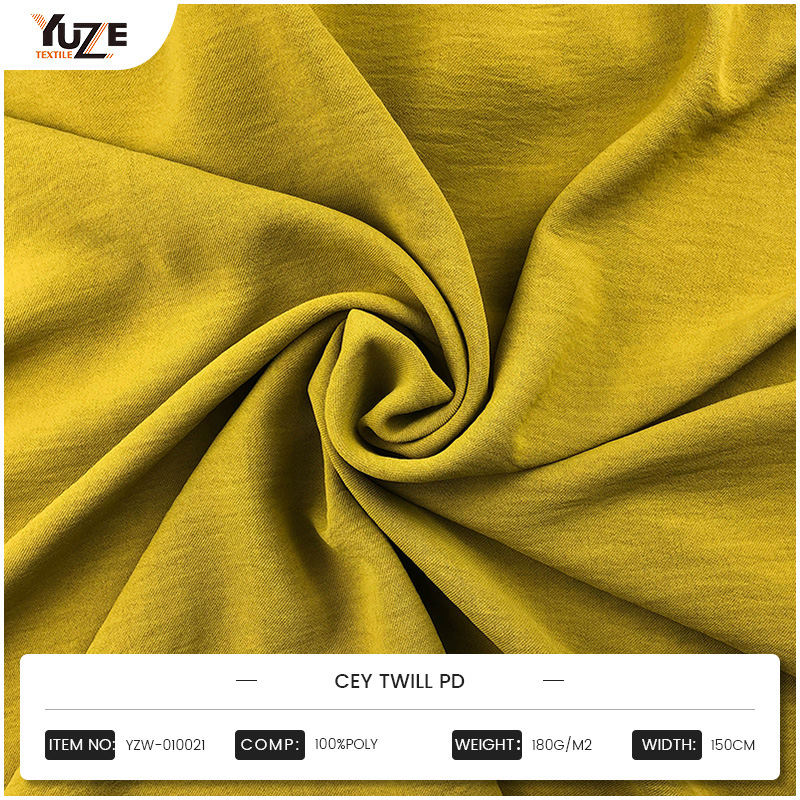 Polyester CEY Twill Fabric for Dresses and Casual TopsThis 100% polyester twill with a 2/2 structure offers a soft hand and sufficient body, making it a reliable choice for dresses and casual tops that require a clean surface and good color absorption.View Product →
Another common construction uses a blend of viscose and polyester. The viscose provides a soft hand and good drape, while the polyester adds strength and stability. When woven in a twill pattern, this blend is suitable for trousers and blouses that need to resist creasing while maintaining a smooth appearance.
Properties and Advantages of Twill Fabric
Twill fabrics are widely used in garment manufacturing because the structure gives a specific combination of performance benefits. The most important advantage is that the diagonal floats allow yarns to move more easily than in a plain weave. This makes the fabric softer and more pliable while still having enough thickness to drape well.
Another practical benefit is that twill fabrics are less likely to show stains and wear marks than plain weave. The diagonal ribs create a textured surface that hides minor soil, and the higher float length means the fabric can be woven denser without becoming stiff. This is why casual pants, work jackets, and sturdy skirts are often made from twill.
In terms of durability, twill fabrics are generally strong because the interlacing density can be controlled. A tight 2/1 or 3/1 twill can withstand repeated washing and abrasion. For stretch applications, the structure also allows the integration of spandex fibers without the fabric becoming too rigid. This flexibility is important for modern activewear and slim-fit clothing.
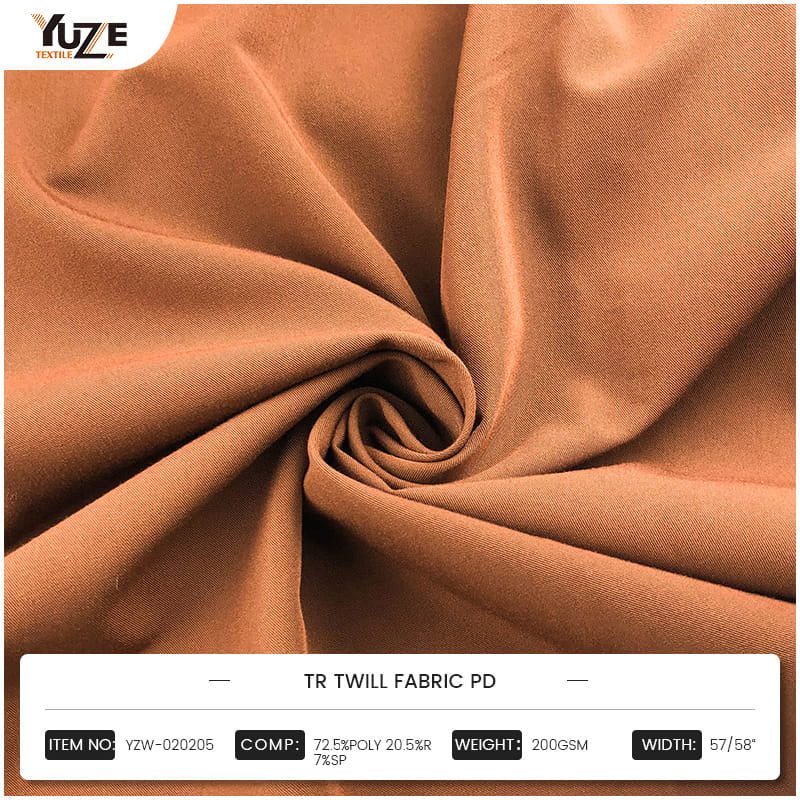 Stretch TR Twill Fabric with Spandex for ActivewearThis TR twill blend combines polyester, rayon, and spandex to provide flexibility and durability. Its 200gsm weight and tight weave suit activewear and slim-fit clothing that withstands repeated washing and abrasion.View Product →
For fabric buyers, the key point is that twill is not a single specification. A lightweight twill with a fine yarn behaves like a shirt fabric, while a heavy twill with a thick yarn behaves like a canvas. The same weave can be used for summer dresses and winter jackets if the yarn count and finishing route are adjusted. In our daily work at the mill, we also see twill used in home textiles such as cushion covers and upholstery because the diagonal ribs give a satisfying tactile quality that soft plains often lack.
Twill vs. Plain Weave and Satin Weave
To understand twill fully, it helps to compare it with the other two fundamental weaves. The differences are mainly in the float length and the way the fabric surface looks.
| Weave | Float Length | Surface Appearance | Durability | Drape |
|---|---|---|---|---|
| Plain | 1/1 | Flat, small grid | Highest when densely woven | Stiffer |
| Twill | 2/1, 2/2, 3/1 | Diagonal ribs | High | Softer |
| Satin | 4/1 or longer | Smooth, lustrous face | Lower due to long floats | Very fluid |
Plain weave is the most rigid because every warp end is interlaced with every weft pick. This gives maximum stability but limits the softness. Satin weave has long floats that create a glossy side but make the fabric more delicate and prone to snagging. Twill sits between the two: it is less rigid than plain, more durable than satin, and it creates a distinctive diagonal texture that is attractive in both apparel and interiors.
How to Specify Twill Fabric for Production
When you evaluate twill fabrics for a collection, the first thing to verify is the fiber composition. Twill can be woven from cotton, polyester, viscose, Tencel, wool, or blends. Each fiber changes how the diagonal pattern looks and how the fabric performs. The advantages of woven fabrics become especially clear when you compare a dense twill with a lighter plain weave in the same fiber. In many cases, twill offers better drape and wrinkle resistance without sacrificing strength.
After the fiber, check the construction parameters: yarn count, ends per inch, picks per inch, and weight. A 2/2 twill at 170 gsm works well for a blouse, while a 3/1 twill at 300 gsm is better for a winter jacket. The diagonal direction should also match your garment design. Right-hand twill is the most common, but left-hand twill can be used to create a different visual effect. If your pattern requires a specific orientation, we can adjust the loom settings and confirm the direction on the greige cloth.
Finish treatments also affect the final product. A peach-skin or brushed finish can make a heavy twill feel softer. A water-repellent finish can add functionality without changing the weave. For our rayon woven fabrics, the twill pattern is often combined with a digital print or a garment wash to achieve a premium look. In a production context, we strongly recommend approving a physical swatch before bulk cutting. This is the only way to confirm that the diagonal ribs, surface finish, and color tone match your design intent.
In addition to visual inspection, use laboratory tests to validate performance. For heavy twill, a common requirement is an abrasion resistance of at least 20,000 Martindale cycles. For garments that will be washed frequently, ask for shrinkage and color fastness data after the finishing process. A responsible supplier will provide free samples and free analysis support before you commit a production order. When a new twill structure is developed, we inspect every piece before packing so the delivered goods meet the same standard as the approved sample.
Twill in Our Product Range
At YUZE Textile, our woven fabric range includes several twill variants because the structure is so versatile. We develop polyester twill, rayon-poly twill, cotton twill, and T/R twill in different weights and finishes. The company’s own design team works with clients to customize yarn composition, weave ratio, and after-treatment so the final fabric fits the intended garment category, from casual pants and blouses to workwear and sportswear.
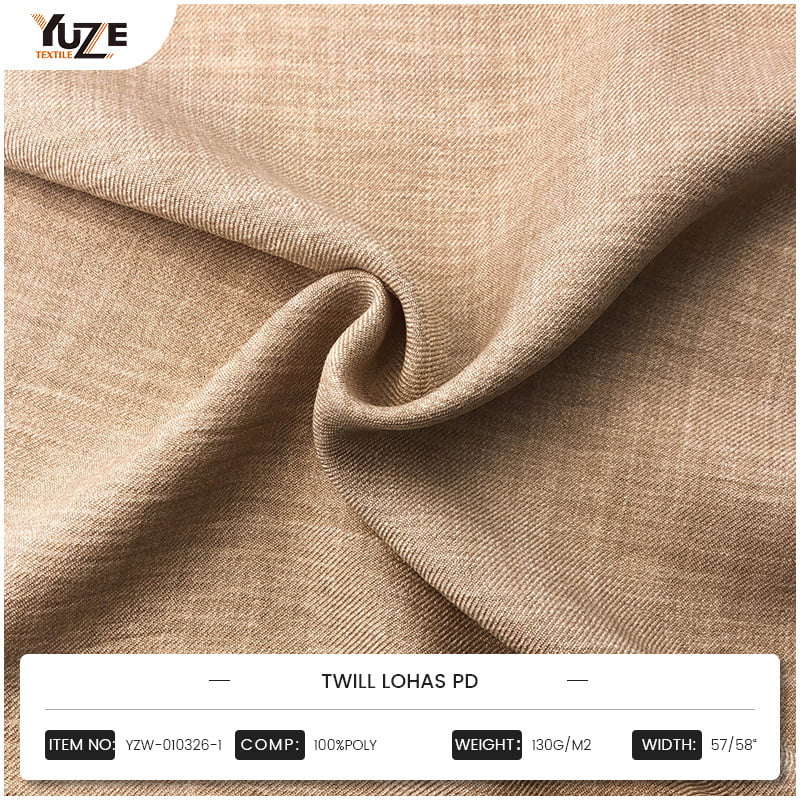 Lightweight Polyester Twill Fabric for Relaxed TrousersThis 100% polyester twill features a lightweight structure and soft hand, ideal for relaxed trousers and dresses. The diagonal weave adds subtle visual depth, giving finished garments a premium appearance.View Product →
If a project calls for a sustainable look, our Twill LOHAS fabric offers a lightweight structure with a soft hand, developed for relaxed trousers and dresses. When a thicker handle is needed, the CEY twill and T/R twill versions provide more body. In each case, the diagonal weave adds a subtle visual depth that gives the finished garment a more premium appearance than a plain flat surface.
Understanding what twill means is the starting point. The next step is to talk with a supplier who can translate that definition into a precise, repeatable fabric specification. Because twill is a weaving structure that interacts with fiber, yarn, and finishing in multiple ways, a reliable manufacturer will guide you through the trade-offs and help you avoid sampling errors. For more details on how woven structures affect garment performance, explore our industry notes on woven fabrics or contact our sales team for a fabric analysis session.



.jpg)
