.png)
 English
 Español
When someone asks "what does pique mean?" the answer depends on whether they are reading a novel or browsing fabric swatches. In everyday English, pique is a verb that means to excite or arouse, and a noun that names a short-lived feeling of irritation. In the textile trade, piqué (usually spelled with an accent) describes a knit fabric with a raised, geometric texture. Both meanings come from the same French root: piquer, to prick. If you are sourcing fabrics for garments, the textile sense is the one that matters most, and it carries practical implications for weight, stretch, finishing, and supplier reliability. Here is the full answer, from the dictionary definition to the fabric you can order by the roll.
Pique in Everyday English: A Quick Definition
Pique first appeared in English in the 1600s, borrowed from French. As a verb, it means to stimulate, provoke, or arouse a feeling. You might say: "The design piqued my interest" or "The sample piqued the buyer's curiosity." It can also mean to cause a specific reaction: "The delay piqued her annoyance."
As a noun, pique is a feeling of wounded pride or resentment. This is a more literary, formal word than "anger." A person who leaves a meeting early because their suggestion was ignored is acting out of pique. The noun is almost always used in the phrase "in a fit of pique" or "out of pique."
Pronunciation matters for both spellings. Pique and piqué are often said as "peek" in the word sense and "pee-KAY" in fabric contexts, but both derive from piquer. Because "peak" and "peek" sound identical, writers frequently mix them up. You should write "pique my interest," not "peak my interest." A "peak" is a high point; a "peek" is a quick look. Pique alone is the verb or noun connected to emotion and arousal.
For a fabric buyer, everyday pique matters mainly because it can confuse search terms. If you type "pique" into a supplier's search bar or a sitemap, the results may include both language-related articles and textile products. Understanding how the word is used in each context helps you filter the noise and find the material you actually need.
What Does Piqué Mean in Textiles?
Piqué is a French word with a different pronunciation in English. With the accent, it is usually said as "pee-KAY" in fabric contexts, though many trade professionals simply say "pique." The word comes from piquer, which means to prick, poke, or quilt. The name refers to the way the fabric is made: needles or looms create raised lines or small geometric patterns that look as if the surface has been pricked or stitched.
Piqué is a knit construction, not a simple weave. In a knitted piqué, loops are transferred between needles to create a texture of small diamonds, waffles, or birdseye patterns. The result is a durable, breathable fabric with a distinctive surface. The raised texture is not just decorative; it creates small air pockets that hold the fabric slightly away from the skin, which is why piqué is a classic choice for warm-weather clothing.
There is also a woven piqué, where a yarn is woven with a raised effect to produce a different appearance. Some woven piqué fabrics have a subtle vertical or diagonal rib. In China's textile export market, woven piqué often appears in rayon/nylon/spandex blends and in polyester or cotton mixes. The term "pq" sometimes appears in product codes, and it is a common shorthand for piqué-like structures.
How Piqué Fabric Is Made
The raw material determines most of the fabric's performance. Cotton piqué is the traditional choice for polo shirts. It breathes well, absorbs moisture, and has a soft hand against the skin. Polyester piqué adds durability and helps the fabric hold its shape after repeated washes. Rayon and viscose piqué gives a smoother drape and a cooler hand. Spandex, when added in small percentages, provides stretch and recovery.
In knitting, piqué is typically produced on a double jersey machine or a jacquard knit machine. The machine uses two sets of needles to interlock loops and create the raised motif. The pattern can be a simple birdseye or a complex geometric design. After knitting, the fabric is dyed, printed, or finished to meet the customer's specifications.
Finishing methods matter a great deal. Enzyme washing softens cotton and removes surface fuzz. Brushing can add warmth for autumn and winter garments. Cold-touch finishing makes polyester blends feel cooler. Embossing, creasing, and bonding add texture or structure. A factory that has its own design team and post-processing capacity can develop custom piqué-like fabrics from a basic jersey or Roma construction.
A textile manufacturer in Shaoxing, for example, sits close to a major fabric market and can source a wide range of yarns. The company may offer free samples and free analysis before a buyer commits to a bulk order. This reduces the risk of ordering a material that fails on hand feel or performance. For a piqué program, such pre-sales service is valuable because the fabric must meet both visual and functional requirements.
Piqué vs. Other Common Textures
Piqué is often compared with other knit structures. Single jersey is smooth and lightweight; rib has vertical lines; Ponte Roma is thicker and more stable; waffle has a honeycomb pattern. Piqué differs from these because it uses a specific loop transfer to create a raised, geometric surface.
| Fabric Type | Typical Weight | Character | Common Uses |
|---|---|---|---|
| Piqué | 180-220 gsm | raised texture, breathable | polo shirts, dresses |
| Single Jersey | 140-180 gsm | smooth, soft | T-shirts, casual wear |
| Rib | 180-240 gsm | vertical stretch lines | cuffs, tanks, tops |
| Ponte Roma | 240-320 gsm | dense, stable | skirts, trousers, jackets |
| Waffle | 150-200 gsm | honeycomb texture | homewear, loungewear |
For garment production, piqué sits well between single jersey and Ponte Roma. It has enough structure to stand away from the body but enough drape to move with the wearer. If you need a firmer, more stable piqué, choose a Roma-style construction. If you want a lighter, more breathable version, choose a cotton or rayon/poly blend.
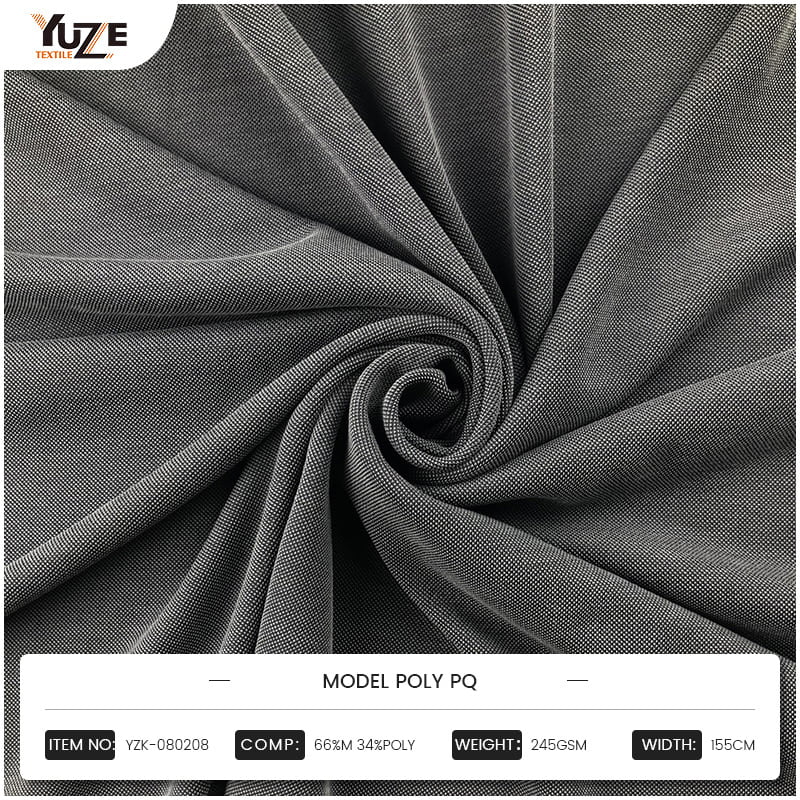 Modal and Polyester Piqué Fabric with Softness and StretchThis model/poly piqué offers softness and stretch in a single jersey construction, making it a useful reference for evaluating piqué fabrics for fashion programs before committing to full production.View Product →
When evaluating a piqué or piqué-like fabric for a fashion program, look at the product specification and the actual hand feel. One useful reference is a model/poly pique that offers softness and stretch in a single jersey construction. A buyer can compare the sample against the target garment before committing to a full production run.
Key Characteristics and Benefits of Piqué Fabric
Breathability comes from the raised texture. The small ridges and loops hold the fabric slightly away from the skin, allowing air to move. This makes piqué particularly comfortable in humid weather. Cotton piqué absorbs moisture from the body and evaporates it slowly, keeping the wearer cool rather than sticky.
Moisture management improves when polyester is blended with cotton. Polyester fibers wick moisture to the surface, where it can dry faster. Many activewear brands use a piqué construction because the texture dries more quickly than plain jersey and does not cling to the body during exercise.
Wrinkle resistance is another benefit. The geometric texture hides creases that would be obvious on a smooth fabric. This is one reason piqué is a standard choice for polo shirts and other garments that may be worn without ironing. After enzyme washing, the fabric becomes even softer while keeping its structure.
Durability comes from the double knit construction. Small loops are interlocked in a way that resists stretching and tearing. Piqué fabrics usually survive repeated washing and wearing without developing the baggy, tired look that can affect lightweight single jersey.
Stretch and recovery depend on spandex. A typical performance piqué may contain 2% to 7% spandex. After stretch, the fabric should return to its original shape. This property is critical for fitted garments, sportswear, and trousers. A piqué that loses its recovery will sag at the elbows and knees.
Color retention matters in production. Cotton piqué has excellent dye affinity, while polyester blends require disperse dyes. A skilled dyehouse can achieve a level color across the whole batch. If a supplier uses lower-cost dyes, the fabric may fade after a few washes or leave color marks when rubbed.
What to Consider When Buying Piqué Fabric in Bulk
Composition is the first specification to define. A 100% cotton piqué feels natural and breathes well, but it will shrink and may need ironing. A CVC (cotton/viscose) blend offers softness and drape. A TC (polyester/cotton) blend improves strength and wrinkle resistance. A rayon or viscose and polyester blend gives a silkier hand and a cooler feel. Each material changes the price and the behavior of the finished garment.
Weight is the next decision. A light piqué of 180 to 200 gsm is suitable for summer shirts. A mid-weight of 220 to 260 gsm works for polo shirts and dresses. A heavier weight of 280 gsm or above gives body for jackets and trousers. The same piqué structure can be made at different weights by using different yarn counts and machine gauges.
Yarn count affects the surface. Finer counts like 40S or 50S deliver a smooth, refined texture. Coarser counts like 20S or 30S produce a more pronounced piqué and a firmer hand. If the fabric will be used for a high-end dress, a 40S or 50S weave gives a better drape. If the target is a classic polo shirt, a 30S piqué offers the familiar structure.
Stretch and recovery deserve special attention. Knitted fabrics achieve elasticity through the yarn and the loop structure. To understand this further, see how is the elasticity of knitted fabrics achieved. This technical insight matters when you specify a piqué with spandex for activewear. The percentage of spandex, the type of yarn, and the finishing process all influence recovery. A test of 20% stretch and 95% recovery after 10 minutes is a useful benchmark.
Shrinkage is a common source of disputes. Cotton piqué may shrink 3% to 5% after home washing. Rayon blends can shrink more. Pre-shrinking and enzyme washing reduce this risk. A responsible supplier should provide wash test data or recommend a suitable finishing route. If your factory cuts garments before the fabric is stabilized, you may lose a full size after the first wash.
Colorfastness is also measured on a grade scale. For apparel, grade 3-4 is generally acceptable for wash fastness; grade 4 or higher is better for light fastness. If the piqué will be laundered frequently or exposed to sunlight, use a higher grade. Dark colors such as black and navy are more likely to bleed. The dyeing process and the quality of the dyes determine the final rating.
Finishing is where a piqué can be made ordinary or excellent. Enzyme washing adds softness. Brushing adds warmth. A cold-touch finishing helps polyester blends feel cooler. Embossing can create an additional pattern. Foil and embroidery produce a decorative surface. Bonding adds structure and water resistance. Each finishing step changes the fabric's cost and lead time, so the buyer should specify the end use before selecting a route.
Quality control is a key purchasing factor. In the textile trade, a significant risk is receiving a batch with different widths, inconsistent weight, or shade variation. A reliable fabric manufacturer and exporter inspects every piece before packing. Ask the supplier about their inspection process and whether they provide free samples and free analysis. If a supplier can analyze your target garment and recommend the correct piqué, it often means the company has the technical experience to support a custom order.
Lead time should be discussed early. A standard piqué in stock can be shipped quickly, but a custom development requires yarn sourcing, knitting, dyeing, and finishing. Depending on the yarn availability and the complexity of the finishing, the total lead time may range from 15 to 45 days. For seasonal fashion, this is enough time to plan a production schedule.
Pricing is determined by the raw material, the yarn count, the finishing, and the order quantity. A 40S rayon/nylon/spandex piqué costs more than a basic polyester/cotton piqué. If the price difference can be justified by the end-use performance, a higher-cost fabric may still be the right choice. Comparison with a product specification helps a buyer avoid paying for features that the garment does not need.
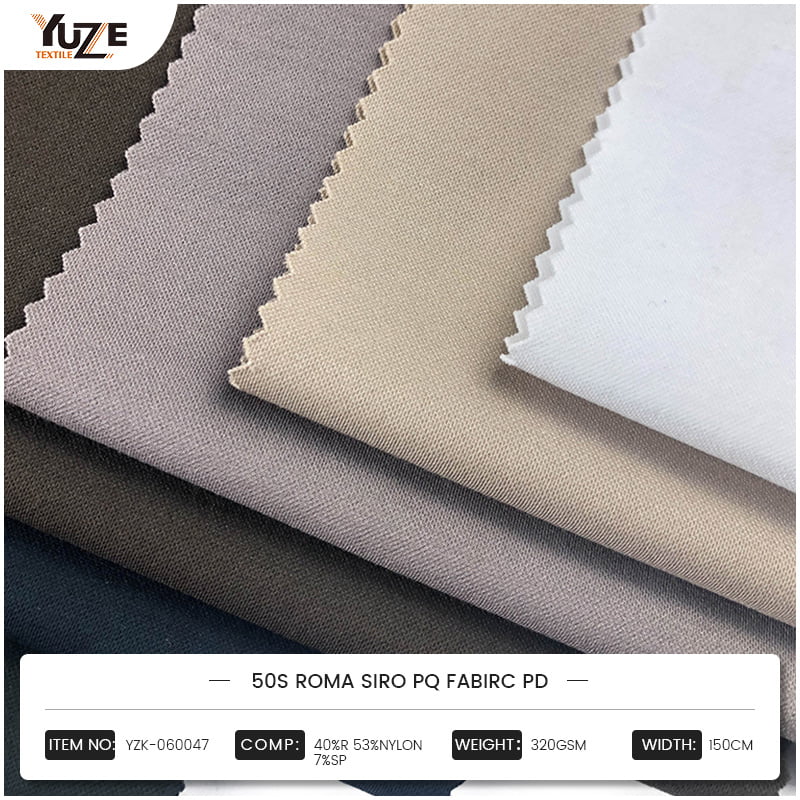 Roma Siro Piqué Fabric in Rayon, Nylon, and SpandexThis 50S Roma Siro piqué combines rayon, nylon, and spandex, providing performance and structure suitable for polo shirts, justifying a higher cost in end-use applications.View Product →
Common End-Use Applications of Piqué
Polo shirts are the most well-known application. The piqué construction adds structure to the collar area and keeps the shirt from clinging. In the early twentieth century, tennis players adopted piqué because it was cooler and more comfortable than plain jersey. Today, piqué polo shirts remain a staple in school uniforms, golf wear, and casual office dress.
Dresses and skirts use a lighter piqué. A cotton or rayon/poly piqué gives the garment enough body to hold a silhouette without being stiff. The textured surface catches the light and makes a simple dress look more intentional than a plain jersey dress.
Activewear and yoga apparel use a stretch piqué with spandex. The texture helps with ventilation during exercise, and the compression can support muscles. A dense Ponte Roma or a jogging piqué can also withstand repeated stretching and washing, which is essential for leggings and sports tops.
Trousers benefit from a heavier piqué. A dense structure resists bagging and shows fewer wrinkles. The texture also masks small marks better than flat woven fabrics. This makes piqué suitable for tailored casual trousers and workwear.
Uniforms are another area. School uniforms, hospitality uniforms, and industrial workwear often rely on piqué because it looks neat, is easy to wash, and does not require constant ironing. A polyester/cotton blend with a moisture-wicking finish helps employees stay comfortable in a busy environment.
Children's clothing often uses a soft cotton piqué. The raised texture is gentle against the skin, and the fabric stands up to rough play. An enzyme-washed piqué feels even softer and is less likely to irritate sensitive skin. A fashion fabric manufacturer can offer piqué in a range of pastel and bright colors to match children's seasonal collections.
If your program needs a piqué that combines drape and stretch, a 40S N/R Roma vortex construction is worth testing. This kind of fabric gives a smooth back and a textured front, which is useful for dresses, skirts, and smart casual tops.
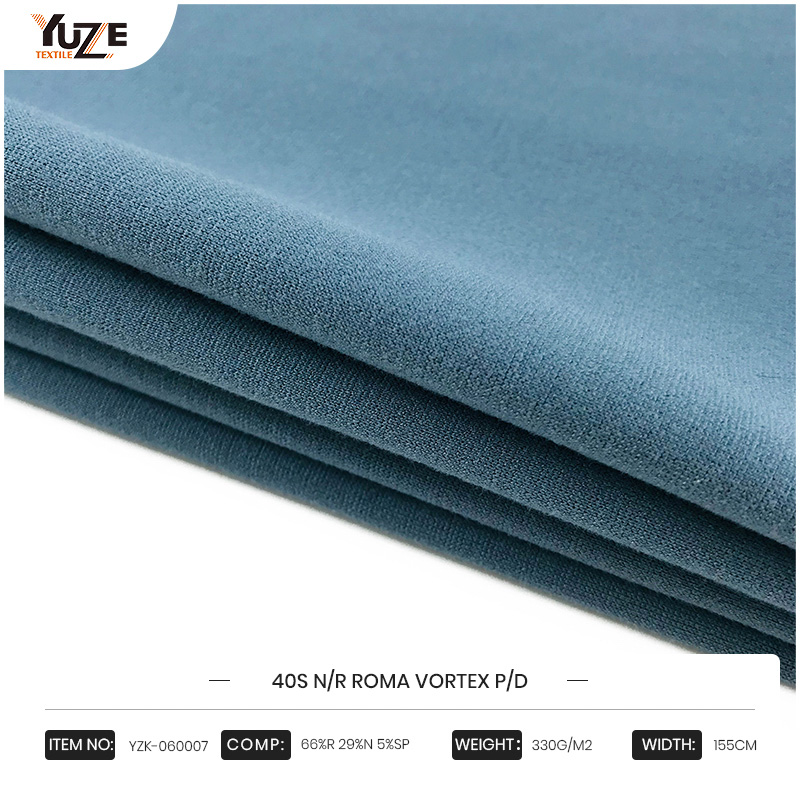 40S Roma Vortex Piqué with Rayon, Nylon, and SpandexThis 40S N/R Roma vortex piqué offers drape and stretch with a smooth back and textured front, ideal for dresses, skirts, and smart casual tops.View Product →
How to Sample and Source Piqué Fabric Like a Professional
Start with the end use. A polo shirt needs a different piqué than a yoga legging. Write down the weight, composition, stretch, and finish you need. Then look for a supplier that can provide a sample that matches those parameters. A professional fabric supplier will ask questions about the garment, the production process, and the target market before recommending a product.
Request free samples and free analysis. A textile manufacturer and exporter in China, especially one located near a major textile market, can usually provide several samples for you to evaluate. The analysis includes weight, width, fiber content, and sometimes shrinkage data. This gives you a baseline to compare against your own specifications.
Test the sample against your garment. Sew a prototype, launder it, and check for shrink, color bleeding, twisting, and surface damage. A piqué that looks good in the sample may behave differently after production. Pay attention to the seam puckering and the way the fabric recovers after being stretched.
Compare at least three suppliers. Price is not the only factor. Consider the supplier's ability to develop custom colors, the sample lead time, the bulk lead time, and the quality control process. A supplier that inspects every piece before packing and supports after-sales service is usually a safer choice for a long-term program.
Discuss a custom order if your design is not available in the standard range. A factory with a design team can develop a new piqué from scratch. The process may include yarn selection, gauge adjustment, dyeing trials, and hand-feel testing. It takes a little longer, but the result is a fabric that matches your brand's exact requirements.
Finally, confirm the logistics. Piqué is often sold in rolls of 60 to 150 meters. The width may range from 150 cm to 180 cm, depending on the machine. Check the packing, the shipping method, and the payment terms. A transparent supplier will provide all the details before you place the order.
Conclusion
So what does pique mean? In everyday language, pique is a word for excitement or resentment. In the textile industry, piqué is a fabric with a raised, geometric texture that serves a wide range of clothing applications. The two meanings are not unrelated; both trace back to the idea of pricking or stimulating the surface.
For garment designers and sourcing professionals, piqué offers a practical balance of breathability, durability, and visual interest. Whether you are making polo shirts, dresses, activewear, or trousers, a well-specified piqué can elevate the garment. When buying, focus on composition, weight, stretch, shrinkage, colorfastness, and the finishing route. Partner with a supplier that offers free samples, reliable quality control, and support for custom development.
If you are comparing piqué options for your next collection, request a sample and test it against your own standards. The right fabric is the one that performs in production and looks good on the final garment. That is the practical answer behind the meaning of piqué.



.jpg)
