English
 Español
The highest quality cotton fabric is not a single product you can name off a list. It is a convergence of four things: extra-long-staple cotton fibre, combed and ring-spun yarn, a construction that matches the garment, and finishing done without shortcuts. When those four line up, the cloth feels smooth against skin, recovers its shape after thirty washes, dyes deep and even, and keeps its shade through a season of sunlight. When one of them fails, the label still reads "100% cotton" and the garment still disappoints the customer at the third wash.
A scene that plays out in sampling rooms every week: two 40s cotton poplin swatches land on the table, both around 120 gsm, both described by their suppliers as combed cotton. The first feels crisp and dry, springs back when crushed in the hand, and shrinks 2.1% after three home launderings. The second feels flat, creases sharply and stays creased, and loses 5.4%. The weave is identical. The weight is identical. The difference sits in the fibre grade behind the yarn, how much short fibre the combing actually removed, and whether the fabric passed through a properly controlled sanforizing range. That gap is what buyers are really paying for, and it is invisible on a spec sheet unless you know which numbers to ask for.
The Four Layers That Decide Whether Cotton Is Premium
Quality in cotton is cumulative and it is not recoverable. You cannot fix a short-staple fibre with aggressive mercerization, and you cannot fix a hairy yarn with a softener. Each layer sets a ceiling on the layers above it, which is why two mills using the same loom and the same dyehouse can produce fabric that behaves like two different materials.
Layer one: the fibre
Staple length, length uniformity, fineness and maturity determine how the yarn spins, how much it hairies, how strong it is at the same count, and how it takes dye. Long, uniform, mature fibre spins into a smooth, strong yarn with few protruding fibre ends. Short, variable fibre spins into a weaker yarn that needs more twist to hold together, and that extra twist is what makes cheap cotton feel dry and slightly rough.
Layer two: the yarn
Combing, spinning system, twist level and ply structure turn fibre into yarn. Combed yarn has had short fibre and neps removed before spinning; carded yarn has not. Ring spinning produces a parallel, compact yarn with good strength; open-end (rotor) spinning is faster and cheaper but produces a yarn that is bulkier, weaker at fine counts, and more likely to pill in knit structures.
Layer three: the construction
Poplin, voile, sateen, twill, double crepe, single jersey, interlock and rib all express the same yarn in completely different ways. Construction controls drape, opacity, air permeability, seam stability and how the fabric ages. A 60s combed yarn in a tightly sett poplin reads as formal shirtings; the same yarn in an open voile reads as summer dresses.
Layer four: the finishing
Singeing, desizing, scouring, bleaching, mercerizing, dyeing, softening, sanforizing and calendering decide whether the fabric keeps its dimensional stability and colour, or loses both. Finishing is also where cost gets quietly removed: less wash, less heat-setting, a cheaper softener, a shorter sanforizing range.
The practical consequence for a buyer is this: ask about all four layers, not one. A supplier who can only talk about thread count is telling you something about their depth.
Fibre First: Species, Staple Length and Micronaire
Almost all cotton in commercial circulation comes from two species. Upland cotton (Gossypium hirsutum) accounts for the large majority of world production and covers the ordinary range of apparel and home textile fabrics. Pima-type cottons (Gossypium barbadense), sold under names such as American Pima and Egyptian Giza, produce the extra-long-staple fibre that premium cotton fabric is built from.
The measurable difference is not marketing. Extra-long-staple fibre is longer, finer and stronger, and those three properties compound. Longer fibre means fewer ends within a given length of yarn, so there are fewer weak points and fewer hairs sticking out of the surface. Finer fibre means more fibres can be packed into the same yarn cross-section, which raises strength and gives dyers more surface area for deep, level shades. Stronger fibre means the spinner can use lower twist and still hit the required strength, and lower twist is what reads to the hand as softness rather than as smoothness.
| Fibre class | Species | Typical staple length | Micronaire | Fibre tenacity | Where it realistically belongs |
|---|---|---|---|---|---|
| Standard upland | G. hirsutum | 25–28 mm | 4.0–4.9 | 26–29 g/tex | Denim, canvas, workwear, commodity jersey, sheeting |
| Long-staple upland | G. hirsutum selections | 28–32 mm | 3.8–4.3 | 28–31 g/tex | Good shirting, combed jersey, poplin, twill |
| Extra-long-staple (Pima type) | G. barbadense | 34–38 mm | 3.0–3.7 | 30–34 g/tex | Premium poplin, fine jersey, voile, high-end crepe |
| Extra-fine ELS (Giza 45 class) | G. barbadense | 36–40 mm+ | 2.9–3.4 | 32–36 g/tex | Top-tier shirtings and knits, very limited volume |
Two practical warnings. First, staple length alone is not enough: length uniformity matters as much, because a batch with a long average and a wide distribution still gives the spinner plenty of short fibre to deal with. Second, micronaire is a combined fineness and maturity reading, not a pure fineness measure. An immature cotton can read fine and still dye poorly and feel thin. When a mill quotes "long staple", the honest follow-up is: what is the uniformity index, and is the fibre combed?
Yarn: Why Combed Beat Carded and Ring Beat Rotor
If you only have room to ask one question about a cotton fabric, ask whether the yarn is combed. Combing is a mechanical process that removes short fibre, neps and trash from the cotton sliver before spinning. It costs money — typically a meaningful percentage of yarn cost — and it changes the fabric permanently, not temporarily.
The visible effects of combing are reduced hairiness, better yarn evenness, higher strength at the same count, and considerably less pilling in knitted structures. In the hand, combed cotton feels smoother and cooler; carded cotton feels slightly fuzzy and, in knits, develops a light surface fuzz after a few washes that never quite disappears.
Spinning system matters just as much at fine counts. Ring-spun yarn lays fibres in a parallel helix with a controlled twist, giving good tenacity and a clean surface. Compact ring spinning goes a step further by condensing the fibre strand before twist, which pulls stray fibres back into the yarn body and cuts hairiness noticeably. Open-end spinning is efficient and makes a tough, uniform yarn for coarse counts, but at 40s and finer it struggles to match ring yarn's strength and smoothness, and its bulkier structure tends to pill faster in single jersey.
| Yarn route | Short fibre removed | Evenness (CVm, approx.) | Surface hairiness | Best use | Cost position |
|---|---|---|---|---|---|
| Carded ring spun | No | 15–18% | Moderate to high | Casual woven, fleece, terry, value jersey | Baseline |
| Combed ring spun | Yes | 12–14% | Low | Shirting poplin, fine jersey, crepe, babywear | Higher |
| Combed compact ring spun | Yes, plus condensation | 11–13% | Very low | Premium jersey, piqué, fine poplin, print bases | Highest |
| Open-end (rotor) | Partly, via cleaning | 13–15% | High but different character | Coarse knits, denim weft, industrial cloth | Low |
| Two-ply combed | Yes | Very good, balanced | Very low | 80s/2 to 120s/2 luxury shirtings | Premium |
Yarn count deserves a plain-language note because it confuses buyers constantly. The English cotton count (Ne) expresses how many 840-yard hanks weigh one pound. So 40s is finer than 20s, and 80s is finer than 40s. Finer is not automatically better. A 100s combed poplin is a beautiful, light, formal shirting that also wrinkles and wears faster at the cuff than a 60s. Fine yarn needs good fibre to exist at all, which is why count is a rough proxy for fibre quality — but only a proxy.
Woven Constructions: Where Fine Cotton Becomes Shirting, Dresses and Crepe
In woven cotton, the relationship between yarn, sett and weave decides everything the customer feels. Higher sett with finer yarn gives a denser, smoother, more opaque cloth. Lower sett with the same yarn gives openness, breathability and drape, at the cost of coverage and seam strength.
Poplin and fine plain weave
Poplin is a plain weave with a fine warp and a slightly heavier weft, producing the characteristic fine cross-rib and a crisp, dry, smooth hand. It is the benchmark shirting construction, and it is unforgiving: because the sett is dense and the yarn fine, any weakness in fibre or combing shows up immediately as a dull surface, poor drape or inconsistent dye uptake. A good 50s to 60s combed cotton poplin at roughly 110–130 gsm is one of the most useful fabrics in a womenswear or menswear range — shirts, blouses, dresses, and light jackets.
 Cotton Poplin with Spandex for Custom Woven FabricA 139 GSM cotton poplin with 3% spandex and 57/58-inch width; view for custom poplin development where stretch and a smooth plain-weave hand matter.View Product →
Voile and lawn
Voile uses high-twist fine yarn in an open sett, giving a semi-sheer, cool, slightly crisp cloth at low weights. Lawn is a fine, closely sett plain weave with a smooth, almost silky surface. Both depend entirely on combed, long-staple yarn; carded yarn in a voile reads as fuzzy rather than airy.
Twill and sateen
Twill's diagonal structure packs more ends per inch than a plain weave, giving higher tensile and tear strength at the same weight, plus better drape and a subtly lustrous face after mercerizing. Sateen's float structure produces a smooth, light-reflective surface that suits dresses and soft tailoring, but the floats are also where abrasion damage appears first — worth remembering for garments that rub at the seat or elbows.
Double crepe and crepe effects
Crepe constructions use high-twist yarn to create a pebbled, dry, springy surface that resists creasing and drapes beautifully. In cotton, the effect is produced either by weaving with high-twist yarns in one or both directions or by finishing that encourages controlled shrinkage. The texture is not a print and cannot be applied afterwards — it lives in the twist. This is one of the constructions where combed ELS yarn pays off most clearly, because high twist on short-fibre yarn simply produces a harsh, kempy cloth. The softness advantages of crepe cotton woven come precisely from this combination of twist geometry and fibre length.
 100% Cotton Double Crepe Woven FabricA 130–135 g/m² cotton double crepe at 132/135 cm width, relevant where a dry, springy crepe surface and custom cotton woven sourcing are required.View Product →
Jacquard and dobby
Jacquard cotton lifts the design into the weave itself, which means pattern definition is limited by yarn quality. Fine, even, low-hairiness yarn gives crisp motifs; fuzzy yarn blurs the edges and makes the pattern read as muddy at any distance. Jacquard is also where weight and sett must be balanced carefully, because float length affects snag resistance.
Knitted Constructions: Jersey, Interlock, Rib and Why Spinning Shows Up Faster
Knits expose yarn quality more brutally than wovens. A single jersey loop is a curved column of yarn, and any short fibre or weak spot sits directly on the surface where abrasion and laundering reach it first. This is why a cheap cotton T-shirt develops a halo of pills within ten wears and a well-made one does not.
Single jersey is the workhorse: light, stretchy, breathable, typically 130–180 gsm. Combed, compact-spun yarn transforms it — the surface stays clean, the print base is smoother, and the fabric holds its shape at the neckline. Interlock is a double-knit structure with two interlocking faces, which gives it more body, better opacity and much lower curling at cut edges; it is the right base for heavier T-shirts, dresses and light suiting. Rib uses alternating knit and purl wales for crosswise stretch, making it the natural choice for cuffs, neckbands, bodycon pieces and fitted tops.
Enzyme washing deserves a mention here because it is often misunderstood. Cellulase enzymes digest protruding fibre ends and slightly relax the surface, producing a soft, peached hand and reduced fuzziness. Done well, it improves comfort and appearance without meaningful strength loss. Done aggressively to hit a softness target cheaply, it thins the fabric and reduces bursting strength — a failure that only appears after several washes in the consumer's hands.
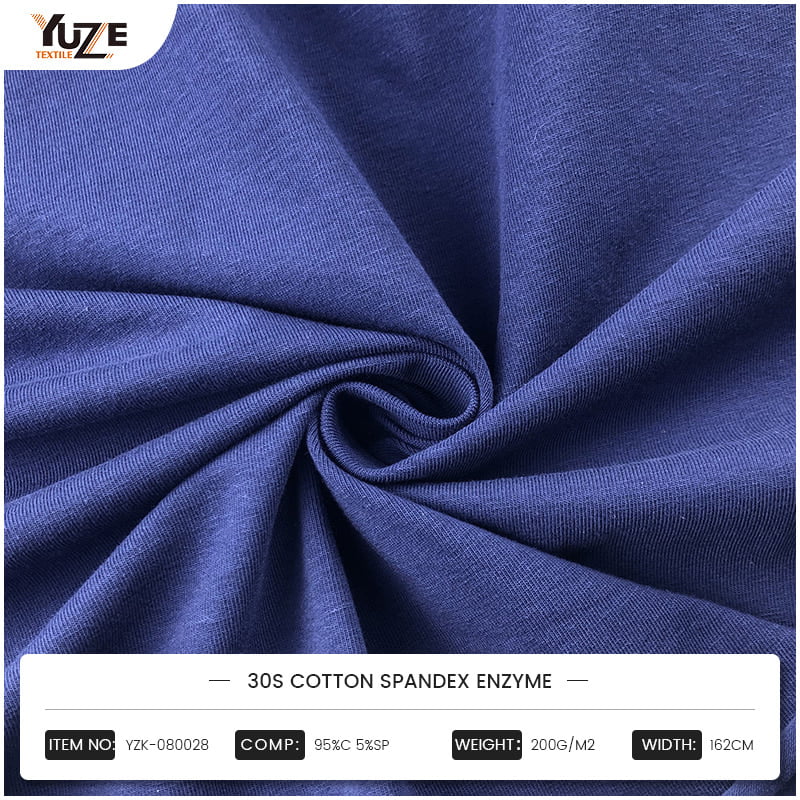 30S Cotton Spandex Enzyme Single Jersey FabricA 200 g/m² single jersey in 95% cotton/5% spandex at 162 cm width, relevant for enzyme-treated knit development with stretch.View Product →
For cotton knits, the practical quality markers are: combed or compact yarn, a declared and tested bursting strength, low shrinkage after three washes, and a pilling grade that holds up to Martindale testing rather than to a hand-feel assessment in the sample room.
Finishing: Where Good Cotton Is Either Protected or Wasted
You can buy excellent greige cotton and ruin it in the dyehouse. Finishing is the stage buyers audit least and where suppliers economize most, so it deserves specific questions.
Singeing and desizing
Singeing passes the fabric over a gas flame to burn off surface hairs, which gives a clean, smooth face and better print definition. Desizing removes the sizing applied before weaving; incomplete desizing leaves a stiff, harsh hand and causes uneven dyeing that only becomes visible after laundering.
Mercerizing
Tensioned treatment with sodium hydroxide swells the fibre, increases lustre, raises tensile strength, and improves dye uptake and depth of shade. Mercerized cotton looks and feels different in a way that cannot be faked with softeners: the surface has a quiet sheen and the colour reads deeper. Mercerization is also frequently applied under tension to knits to control shrinkage and add stability.
Sanforizing and shrinkage control
Sanforizing mechanically compresses the fabric to reduce residual shrinkage. A properly controlled range typically holds woven cotton shirting to within about ±2–3% after laundering; knits are usually specified looser, around ±5%. Any mill quoting "pre-shrunk" without a tested figure is offering a word, not a specification.
Softening, bio-polishing and the durability trade-off
Silicone micro-emulsions give an immediate, luxurious hand at very low cost, but heavy application reduces absorbency, can yellow over time, and makes the fabric feel slick rather than cottony. Buyers who want cotton to feel like cotton should specify a moderate softener and let the fibre and construction do the work. Similarly, aggressive bio-polishing delivers a beautifully smooth surface while quietly lowering tear strength — a genuine trade-off that should be decided deliberately, not discovered in a wash test.
Colour and fastness
Reactive dyeing on well-prepared, well-mercerized cotton gives the deepest, cleanest shades. The specs that matter on the purchase order are colourfastness to washing, to rubbing (wet and dry) and to light, plus a shade-to-shade tolerance agreed against a physical standard rather than a screen image.
Matching the Quality Level to the End Product
"Highest quality" is not absolute; it is the right grade for the garment. Over-specifying wastes money, under-specifying destroys the brand. The table below is the practical mapping most experienced buyers carry in their heads.
| End product | Best cotton construction | Typical weight | Yarn expectation | Non-negotiable spec |
|---|---|---|---|---|
| Formal shirts and blouses | Poplin, fine twill | 100–130 gsm | 50s–80s combed, mercerized | Shrinkage ≤3%, smooth surface, no neps |
| Summer dresses | Voile, lawn, double crepe | 70–120 gsm | 40s–60s combed, high-twist crepe | Drape, opacity where needed, colour levelness |
| Premium T-shirts | Single jersey, compact spun | 140–180 gsm | 30s–40s combed or compact | Pilling ≥3–4, shrinkage ≤5%, clean surface |
| Heavier tops and dresses | Interlock, rib | 180–260 gsm | 30s–40s combed | Recovery after stretch, edge curl control |
| Babywear | Fine jersey, fine poplin, jacquard | 110–160 gsm | 40s combed, low twist | Softness, pH, formaldehyde and azo compliance |
| Casual jackets and trousers | Twill, sateen, bonded cotton | 180–280 gsm | 20s–40s carded or combed | Tear strength, seam slippage, dimensional stability |
A useful way to think about it: the higher the retail price and the closer the fabric sits to skin, the more the fibre and finishing layers matter. The further the fabric sits from skin and the more mechanical stress it takes, the more construction and strength matter. Both are "quality" — just not the same purchase.
The Specifications to Put on a Cotton Purchase Order
Vague quality language causes disputes. Every one of the parameters below can be measured, agreed and inspected, and putting them in writing is the single most effective quality control tool a buyer has.
- Fibre declaration. Species or class, staple length and whether the yarn is combed. Avoid the word "premium" with no definition attached.
- Yarn count and ply. State the count system (Ne) and whether single or two-ply, because "40s" in one mill's shorthand is sometimes a ply-inclusive figure.
- Construction and sett or stitch density. Ends and picks per inch for wovens, courses and wales per inch for knits, plus weight in gsm with a tolerance (commonly ±5%).
- Width and usable width. Include selvedge condition and any edge-to-edge variation allowed.
- Shrinkage. Specify the test method, the number of wash cycles, and the acceptable limit. Woven shirting ±3%, knit jersey ±5% is a common starting point.
- Colourfastness. Washing, wet and dry rubbing, light and, where relevant, perspiration. Agree grey scale ratings numerically, not verbally.
- Pilling and abrasion. Martindale pilling after a stated number of rubs; relevant for knits and for any fabric with a brushed or crepe surface.
- Strength. Tensile and tear for wovens, bursting for knits. This is the spec that protects you when a supplier softens aggressively.
- Skew and spirality. Especially important for striped and checked jersey and for any garment cut on a curve.
- Chemical compliance. pH range, formaldehyde, azo dyes, and the certification scheme your market requires. State the certificate, not the intention.
- Packing and inspection. Roll length and tolerance, shade batching, fold direction, and the inspection standard with an acceptable defect points-per-unit allowance.
None of these are exotic. All of them are cheaper to agree in advance than to argue about after the container ships.
Six Quality Traps Buyers Fall Into With Cotton
1. Chasing thread count
Thread count is easy to inflate by counting multi-ply yarns as separate threads, and it says nothing about fibre or combing. A 200-count fabric made from short-staple, low-twist yarn is worse in every practical way than an honest 120-count made from combed ELS cotton. Ask for sett, yarn count and fibre class instead.
2. Accepting origin claims at face value
"Egyptian cotton" describes where cotton is grown, not quality automatically, and the term has historically been applied loosely. The verifiable question is whether the fibre is extra-long-staple and whether there is documentation linking the yarn back to the declared fibre lot.
3. Blending ELS into a minority share
A fabric advertised as Pima or ELS may contain only a modest percentage, with the balance ordinary upland. At that ratio the hand and performance benefits largely disappear, while the price premium survives. Ask for the blend ratio in writing.
4. Buying softness that does not survive washing
Heavy softener and aggressive bio-polishing read wonderfully in the sample card and fade within five home washes. Always evaluate hand after three launderings, not before the first.
5. Ignoring seam and skew behaviour
Fabric that looks perfect flat can twist at the side seam or slip at the shoulder after a wash cycle. Skew, residual shrinkage and seam slippage are the three specs most often skipped and most often responsible for returned garments.
6. Sampling from a different lot than bulk
Counter-sample quality is a classic pattern: the development team receives a beautifully combed, well-mercerized piece, and bulk arrives from a different yarn lot with visible shade variation between rolls. Ask how shade is batched across the order and what the roll-to-roll tolerance is.
How to Verify Cotton Quality Before You Commit
Verification is a process, not a certificate. Used well, it takes about three weeks and prevents most of the problems that would otherwise surface in a container.
- Request a lab report with the sample, not after the order. Fibre class, yarn count, gsm, shrinkage, colourfastness and pilling are enough to separate serious suppliers from optimistic ones.
- Wash the sample yourself. Three cycles at 40°C, tumble dry, then measure shrinkage and inspect the surface under good light. Most quality problems are visible at this stage.
- Test at the fine end of the range. If you are buying 40s, ask for a 60s swatch from the same yarn program; if the fine count is clean and even, the coarse count almost certainly is too.
- Ask what the mill would refuse. Suppliers who can explain their own rejection criteria have a quality system. Suppliers who claim "no problems ever" usually have neither.
- Confirm bulk against the counter-sample with a documented inspection before packing, not after arrival.
Where a Cotton Programme Like Ours Fits
Shaoxing Yuze Textile works from Keqiao, next to the Shaoxing Textile City cluster, and operates as a fabric manufacturer and exporter covering design development, weaving and knitting, dyeing and printing, and post-processing. In cotton, the practical advantage of that structure is that fibre and yarn decisions sit close to finishing decisions, so a buyer specifying a combed poplin or a high-twist crepe is negotiating with people who can adjust the whole chain rather than one step of it.
The cotton programme runs across both woven and knitted routes: cotton poplin, cotton double crepe, cotton jacquard and double-layer constructions on the woven side, and combed cotton jersey, rib and interlock on the knit side, including enzyme-washed and cool-touch finishes. For buyers developing womenswear, the useful part is not a catalogue but the ability to move a construction — take a poplin hand, apply it to a crepe surface, then run it through an embroidery or embossed post-process and see whether the result still holds its specs. The woven fabric range and knit range are organised to be sampled in exactly that way.
What we can commit to concretely: free samples and free fabric analysis during development, an own design team working on jacquard and print developments, inspection of every piece before packing against agreed criteria, and discussion of custom orders rather than forcing buyers into a fixed list. What we would rather not do is quote a fibre claim we cannot document — if a buyer needs ELS cotton with traceability, that conversation should happen at the start of development, because it changes yarn sourcing and lead time.
Coming back to the original question: the highest quality cotton fabric is extra-long-staple cotton, combed and ideally compact-spun, built into a construction suited to its end use, and finished with real mercerization and controlled shrinkage. Everything above that is application detail. Everything below it is a compromise you will eventually see in a wash test, a shade variation report or a returned garment.
If you are specifying a cotton fabric now, start with the four questions that matter most: what fibre class, is it combed, what are the tested shrinkage and pilling figures, and how is shade batched across the order. Send us a swatch or a target hand, and we will tell you honestly which of those four is doing the work — and which one your current fabric is quietly missing.