.png)
 English
 Español
Ask a simple question – is woven fabric stretchable? – and you will get two different answers depending on who answers it. A textile engineer will say no, because a conventional woven fabric is built from warp and weft yarns locked together at right angles, and that structure leaves almost no room for extension. A garment buyer or a pattern maker will say yes, because stretch woven fabrics have been a standard part of commercial apparel for decades. Both answers are correct, and the gap between them is exactly what you need to understand in order to select fabrics with confidence.
The confusion is understandable. A stretch woven looks like a woven. It has the same crisp edge, the same stable grain, and the same tendency not to curl at a cut edge. But when you pull it across the width, it gives – sometimes 20 to 30 percent – and when you release it, it returns. That combination of woven tailoring behavior and elastic comfort is why stretch wovens appear in fitted blazers, slim trousers, pencil skirts, and body-conscious dresses across the fashion market.
This guide answers the question from a fabric manufacturer's point of view. It explains why ordinary woven fabric resists stretching, how stretch can be engineered into a woven construction with spandex yarns and textured synthetic filaments, what the different stretch directions mean for garment design, and how to test, specify, and buy stretch woven fabrics without the guesswork.
Why Ordinary Woven Fabric Does Not Stretch
To understand why a woven fabric resists stretching, picture the loom. Warp yarns run the full length of the fabric, held under tension as the weft yarn is inserted back and forth across them. Every weft yarn passes over one warp yarn and under the next, so each yarn is trapped at dozens of crossing points. When you pull the fabric, those crossing points lock against one another. The yarn itself is not elastic – a polyester filament or a cotton yarn barely lengthens at all – so the fabric cannot extend until the intersections slide against each other, and the friction at those intersections is precisely what prevents them from sliding.
The weave structure controls how much movement is even theoretically possible. A plain weave, such as poplin or chiffon, has the highest number of interlacings per square centimeter, which makes it the most stable and the least stretchy surface. A twill weave has a diagonal step that reduces the number of interlacings slightly and gives a little more ease. A satin weave, with long floating yarns on the surface, allows more yarn displacement, which is why a satin can feel softer and more fluid than a poplin. But even a satin woven from ordinary filament yarns will only stretch a few percent along its warp or weft. That is not enough for close-fitting apparel.
Woven fabric does have one form of natural give: bias stretch. If you hold a woven fabric at 45 degrees to the grain, diagonally between warp and weft, the yarns can rotate at their intersections and the fabric extends noticeably. That is why bias-cut garments drape and shape themselves, and why a rigid woven fabric can be worn close to the body when it is cut on the bias. But bias stretch is a property of cutting, not of the fabric itself, and it disappears once the yarns are stabilized by seams or fusing. It is not a substitute for a fabric that stretches across the grain when the garment needs to move with the body.
Stretch Is Two Properties: Extension and Recovery
Before looking at how stretch wovens are made, it is worth separating two ideas that are frequently confused: extension and recovery. Extension is how far a fabric can lengthen when you pull it. Recovery is how completely it returns to its original dimension when you let go. A fabric can have excellent extension and poor recovery – pull it once and it stays stretched. That fabric is useless for clothing, because elbows, knees, and hips will create permanent bagging after a few hours of wear.
Stretch percentage is the standard way to express extension. If a 10 centimeter strip of fabric stretches to 12 centimeters before firm resistance, the fabric has roughly 20 percent stretch in that direction. The calculation is simple: divide the added length by the original length and multiply by one hundred. Recovery is usually expressed as the percentage of the original length that the fabric regains within a set time after release, or as the residual elongation left behind. A well-designed stretch woven should show very little residual elongation – ideally under 3 percent after a short rest – because that is what separates a fabric that fits comfortably from one that sags.
Recovery comes mainly from elastane. Spandex filaments can be stretched several times their own length and then snap back almost completely. When those filaments are embedded in a woven fabric, they pull the whole structure back to its original shape. Mechanical stretch, achieved by texturizing yarns or using high-twist crepe yarns, also contributes extension, but its recovery is weaker and slower. That is why serious stretch wovens almost always combine textured or fine synthetic yarns with a small percentage of spandex in at least one direction.
How Stretch Is Engineered into Woven Fabrics
Spandex Core-Spun Yarns
The dominant method is to make a stretchy yarn first, then weave it. The most common construction is a core-spun yarn: a fine spandex filament runs through the center, and staple fibers – cotton, rayon, polyester, or a blend – are spun tightly around it. From the outside, the yarn looks and feels like a normal cotton or rayon yarn, which is why stretch wovens do not look like a typical stretch knit. Inside, the spandex core stores the energy. The spandex content is usually only 2 to 6 percent of the yarn weight, yet that small amount converts a rigid fabric into one with 15 to 30 percent stretch.
Textured and Air-Jet Yarns
Not all woven stretch comes from spandex. Textured polyester yarns, made by false-twist or air-jet texturizing, develop a crimped, springy structure that gives the yarn bulk and a small amount of elastic behavior. Fabrics such as polyester four-way stretch twills and span fabrics often rely on textured yarns in both directions, with spandex added in one or both directions for recovery. That is why a polyester four-way span can feel smooth and dry, stretch in every direction, and still hold its shape after repeated washing. The combination of textured yarns and spandex gives the fabric its characteristic hand: soft, slightly dry, stretchy, and quick to recover.
High-Twist Crepe Yarns
A third route to stretch is twist. Crepe yarns are twisted hard, far more than standard warp or weft yarns, and the twist energy creates tiny kinks in the yarn that behave like springs. When the fabric is relaxed, the kinks pull the yarn short; when the fabric is stretched, the kinks straighten out. Crepe wovens such as baby crepe, tree crepe, or moss crepe have a pebbled surface and a dry, bouncy touch. Their actual stretch is modest, typically 5 to 10 percent, and recovery is not as crisp as a spandex blend, but the effect is enough for a blouse or a lightweight dress to feel comfortable across the shoulders and around the waist.
Weave Structure and Finishing
The weave itself also matters. A satin or twill structure with long floats lets yarns move more freely, so the same spandex yarn produces a higher stretch percentage than it would in a plain weave. Finishing processes are equally important. Heat setting fixes the spandex in place; if the fabric is overstretched during finishing and then heat-set, the residual stretch is permanently reduced. A supplier that controls finishing tension carefully can deliver fabric with reliable stretch, while a supplier that rushes the process can produce the same nominal fabric with half the expected give. This is one of the first things a quality-conscious buyer checks when evaluating stretch woven samples.
Weft Stretch, Warp Stretch, and Bi-Stretch: What the Direction Means
When you specify a stretch woven, the first thing to define is the stretch direction. Weft stretch means the fabric stretches across its width, from selvedge to selvedge. In garment terms, that direction runs around the body for most apparel pieces, which is exactly where ease is needed: across the hip of a skirt, across the chest of a fitted top, across the thigh of a slim trouser. Weft stretch wovens are the workhorses of the market, because the fabric still behaves like a woven along the warp for the center front and center back panels.
Warp stretch runs along the length of the fabric. It is less common because warp yarns must survive the tension of weaving, so spandex in the warp needs careful engineering to avoid excessive stretching on the loom. When warp stretch is used, it is usually paired with weft spandex as well to produce a bi-stretch. True bi-stretch, sometimes called four-way stretch, gives the most freedom of movement, but it also demands more attention in cutting and sewing because the grain can move under pressure or heat. A well-made polyester four-way span fabric, built with textured yarns and spandex in both yarn sets, is a typical example of this family and is widely used for performance trousers and close-fitting dresses.
| Type | Stretch Direction | Typical Stretch | How It Is Made | Common Uses |
|---|---|---|---|---|
| Weft stretch | Across the width | 10–25% | Spandex core-spun yarn in the weft; warp stays rigid | Trousers, skirts, fitted blazers, dresses |
| Warp stretch | Along the length | 8–20% | Spandex core-spun yarn in the warp, often with a rigid weft | Panels that need vertical ease, close-fitting backs |
| Bi-stretch (four-way) | Both directions | 15–30% in each direction | Textured synthetic yarns with spandex in warp and weft | Performance wear, all-way comfort garments |
| Mechanical stretch | Both directions, limited | 3–10% | High-twist crepe or air-textured yarns, no spandex | Blouses, relaxed dresses, soft jackets |
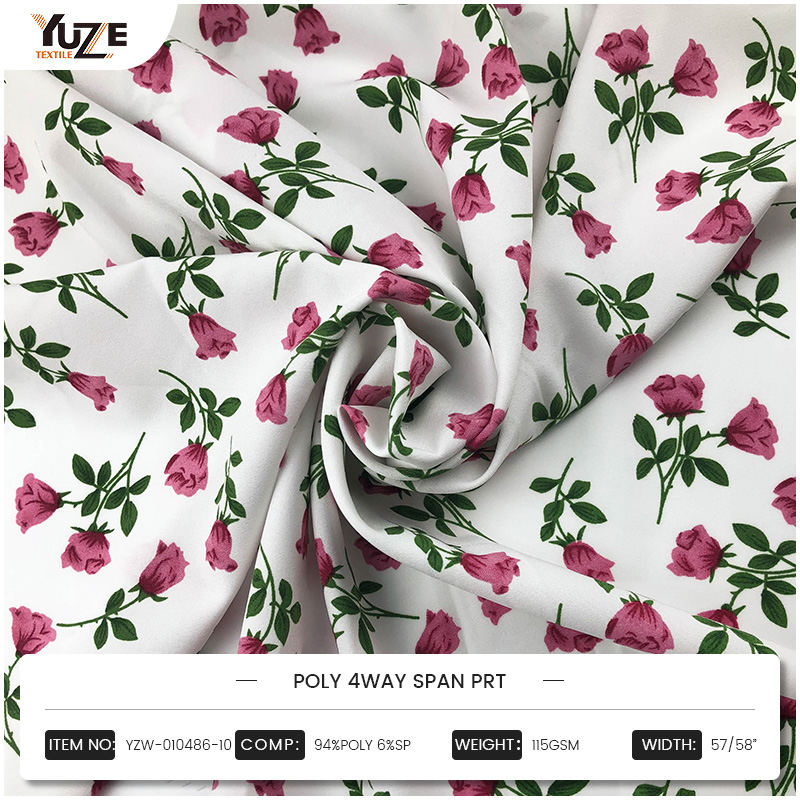 Polyester Four-Way Stretch Woven with Spandex for Performance WearThis lightweight 115 gsm polyester-spandex fabric delivers true bi-stretch, making it ideal for tailored trousers and close-fitting dresses that need freedom of movement without losing shape.View Product →
Mechanical stretch deserves a special note. Because it does not rely on elastane, it gives a softer, less elastic feel and can be applied to natural fiber faces without changing their character. But the recovery is limited, so mechanical stretch wovens are best used where the garment shape does not demand strong elastic pull-back.
Woven Stretch vs. Knit Stretch: Similar Comfort, Different Behavior
Because both knits and stretch wovens can contain spandex, buyers sometimes assume they are interchangeable. They are not. A knitted fabric is built from interlocking loops; each loop can open and close under tension, which gives knits their characteristic two-way stretch and softness. The way the loops organize themselves also makes the raw edge curl, makes the fabric drape closely over the body, and makes seams need to stretch with the material. The mechanics of how knitted fabrics achieve their elasticity are very different from the interlaced, friction-locked structure of a woven cloth, and understanding that difference explains why the two materials behave so differently at the cutting table.
A stretch woven, by contrast, keeps the stability of a woven structure. Its edges stay flat, it holds a pressed crease, it does not ladder if a thread breaks, and it can be cut with the same pattern-making logic as a rigid woven. The spandex provides give, but the woven intersections control how much give and in which direction. The practical result is that a stretch woven can be close-fitting without clinging: it conforms to the body's movement without revealing every contour the way a jersey does.
| Property | Stretch Woven | Knitted Fabric |
|---|---|---|
| Stretch mechanism | Spandex or textured yarns inside an interlaced structure | Interlocking loops that open and close under tension |
| Typical stretch | 10–30% | 20–60% or more |
| Recovery | Good, especially with spandex; stable after many washes | Varies widely; some knits relax permanently |
| Edge and grain | Stable edges, flat grain, holds a pressed crease | Edges curl; grain can distort when cut |
| Drape | More structure and body | Closer, more fluid contact with the body |
| Typical end use | Trousers, blazers, shirts, shift dresses | T-shirts, activewear, underwear, sweaters |
Neither structure is superior overall. A knit will always give more elastic comfort for body-hugging sportswear; a stretch woven will always give structure, tailoring, and a crisp professional finish. That is why the choice between them is usually guided by the garment type rather than by the stretch percentage alone.
Fiber Combinations You Will Actually Meet in the Market
Stretch wovens are rarely sold under a single fiber name. In practice you will meet a handful of recurring blends, each with a predictable hand, price point, and performance profile.
Polyester and spandex is the most common combination in the market, and for good reason. Polyester filaments are strong, affordable, and easy to texturize, which means a mill can build stretch into the yarn structure itself rather than relying only on spandex. Polyester four-way stretch twills, flexible suitings, and lightweight span fabrics dominate the mid-market for womenswear. They hold color well, resist shrinkage in finishing, and recover quickly. For a closer look at why this fiber carries so much of the stretch fabric market, our overview of the advantages of polyester woven fabrics covers durability, color yield, and value.
Rayon and spandex is the combination to choose when you want a matte, fluid face with serious drape. Rayon staple fiber is spun around a spandex core to make stretch slub, stretch poplin, and stretch challis. These fabrics drape like a fine blouse fabric, take prints beautifully, and feel cooler against the skin than a polyester-face stretch fabric. The trade-off is wet strength: rayon is weaker when wet, so finishing control and care instructions matter more. A rayon and spandex woven is at its best in blouses, wide-leg trousers, and dresses where movement and drape matter more than crease resistance.
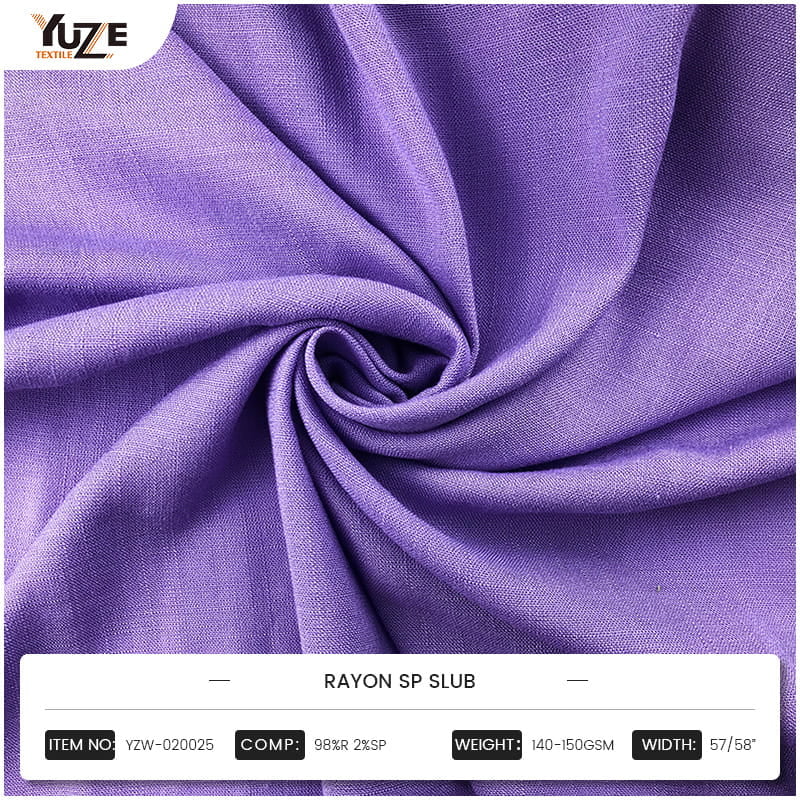 Rayon-Spandex Slub Woven with Fluid Drape and Two-Way GiveA cool, matte rayon blend with 2% spandex, this slub fabric prints well, drapes softly, and suits blouses, wide-leg trousers, and dresses where movement and drape matter more than crease resistance.View Product →
Cotton and spandex appears most often in shirting and stretch denim. It gives the comfort of a soft, breathable cotton face with enough give for a fitted shirt or a close trouser. Cotton stretch wovens are valued for their natural hand and for the way they age, but they have limits: cotton's recovery is mediocre compared with synthetics, and repeated washing can loosen a cotton and spandex fabric unless the resin finishing is carefully controlled.
T/R and spandex, a polyester–rayon blend with a spandex core, is the standard construction for stretch suiting. The rayon brings a soft, dry hand and a matte surface; the polyester brings strength and recovery; the spandex brings the comfort ease. Most stretch ponte roma, stretch twill suiting, and flexible office trousers on the market belong to this family, and it remains the default choice for tailored trousers, blazers, and knit-like woven dresses.
Other combinations appear according to the application: nylon and spandex for performance wear and shaping garments, wool and elastane for premium suiting, and modal or lyocell with spandex for elevated casual wovens. The general rule for a buyer is simple: the higher the synthetic share, the better the recovery; the more natural the face fiber, the better the hand, but the more carefully the fabric must be finished and specified.
How to Test a Woven Fabric for Stretch
You do not need a laboratory to tell whether a woven fabric is stretchy, although a laboratory helps when you need precise numbers for a specification. A simple strip test takes two minutes and gives an honest indication of both extension and recovery.
- Mark two points 10 cm apart in the direction you want to test – across the width for weft stretch, along the length for warp stretch.
- Hold the fabric on both sides of the marks, keeping the marks centered, and pull steadily until you feel firm resistance. Do not jerk the fabric.
- Measure the distance between the marks while you maintain the pull. If it reads 12 cm, the fabric has 20 percent stretch in that direction.
- Release the fabric and let it rest for 30 seconds. Measure again. If it does not return close to 10 cm, recovery is weak.
- Repeat the test on the bias for reference. Bias ease exists even in rigid wovens and should not be confused with true stretch.
- Test again after one wash and after one dry-cleaning cycle, because water and heat can change spandex behavior.
The quick hand test used in mills is even simpler. Stretch the fabric between your hands along the weft. If it resists immediately, it is rigid. If it gives roughly 10 percent and snaps back when you release, it is a comfort stretch. If it gives 20 percent or more and recovers without visible creases, it is a true stretch woven suitable for fitted garments. If it gives easily but stays loose, put it back on the roll.
When you work with a supplier, ask for the stretch and recovery specifications in numbers. Established manufacturers in hub cities such as Shaoxing, close to the China Textile City, routinely test stretch percentage, modulus, and residual elongation as part of inline quality control, and they can provide the data before you commit to bulk production.
What the Stretch Percentage Means for Your Garment
Stretch percentage is not a quality ranking; it is a design parameter. The right value depends on the garment you intend to make.
- 2 to 5 percent: comfort stretch. You can hardly feel the fabric stretch, but seams and body movement are easier. Good for fitted dress shirts, summer dresses, and light jackets.
- 8 to 15 percent: shaping stretch. The fabric can follow the body curve of a pencil skirt, a fitted trouser, or a sheath dress without visible pulling across the hip or waist.
- 15 to 25 percent: freedom stretch. Suitable for body-conscious pieces and performance wovens where bending, reaching, and sitting must not strain the fabric.
- Above 25 percent: unusual in wovens. This level is only meaningful if recovery is strong. If the fabric stretches that far but does not return, the garment will bag at the elbow, the seat, and the knees.
When an elastic bengaline is chosen for structured skirts and trousers, the design intent is a stable ribbed face with just enough weft give to ease over the hip – typically in the 8 to 15 percent range. Pushing it higher by adding more spandex would soften the structure and defeat the purpose of the crisp body. The same logic applies to every stretch woven: decide the hand and the silhouette first, then select the stretch percentage that supports them.
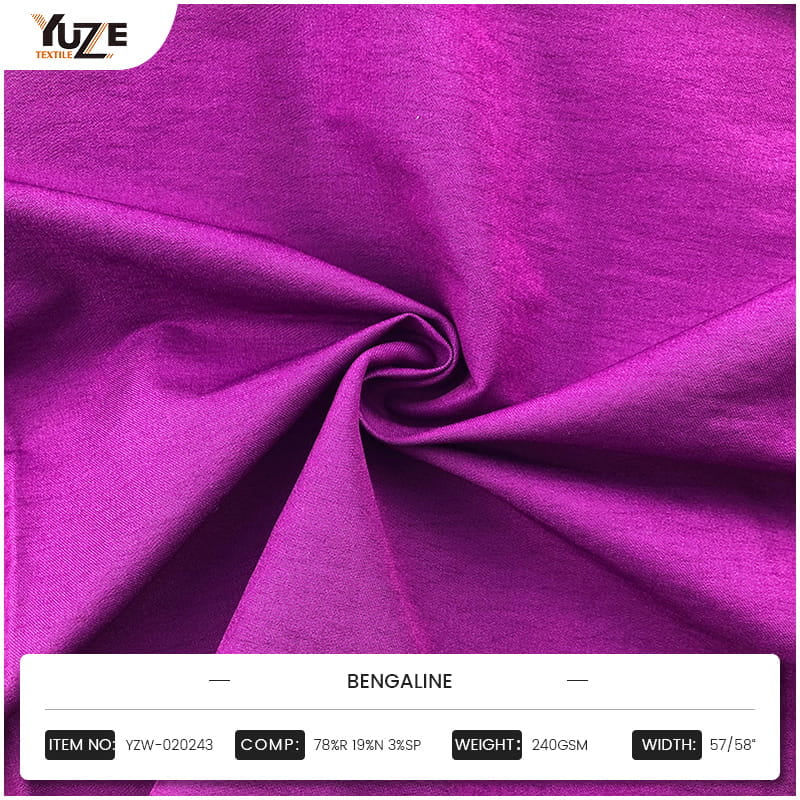 Elastic Bengaline with Rayon, Nylon, and Spandex for Structured GarmentsA substantial 240 gsm bengaline with a stable ribbed face and just enough weft stretch, designed for structured skirts and trousers that ease over the hip while keeping a crisp body.View Product →
Sewing and Handling Stretch Wovens
Stretch wovens look like wovens, but they should be sewn differently from rigid wovens. The first rule is to mark the stretch direction on every cut piece. It is very easy to confuse the weft of a bi-stretch with the warp, and if panels are cut in mixed directions, the garment can hang unevenly.
For the home sewist or the small studio, a stretch needle – a needle designed for elastic fabrics – is the practical choice because it parts the yarns gently instead of cutting them. Set the stitch length slightly longer than usual for a woven and test on a sample to be sure the seam does not gather. Finish seams with an overcast or a narrow zigzag that can stretch with the fabric; a locked straight stitch will break the first time the wearer bends deeply. Press carefully: too much heat degrades spandex, and too much pressure stretches the fabric permanently. Use a pressing cloth, a medium iron setting, and no sliding of the iron while the fabric is under tension.
Interfacing deserves attention as well. A stiff fusible on the collar or placket can cancel the stretch of the entire panel, creating a rigid zone that pulls against the flexible body of the garment. Choose a knitted or weft-insertion interfacing when the area must keep some give, and fuse a sample first to check the behavior.
Buying Stretch Woven Fabrics: What to Verify with Your Supplier
When a stretch woven fails in production, the problem is rarely the design. It is almost always a mismatch between the specification and the delivered goods – or a specification that was never written in the first place.
The first item to verify is the stretch direction and percentage, with numbers. A supplier should be able to state "20 percent weft stretch, 5 percent warp stretch" rather than simply "it has stretch." Ask which test method was used and request the recovery value as well. In our own work as a manufacturer and exporter, we treat stretch percentage and residual elongation as standard fields on every sample approval form, and buyers should expect no less from any mill they work with.
The second item is consistency. Spandex percentage can vary slightly between production lots, and finishing tension can change the stretch even when the yarn count is identical. Ask for the same internal product code when you repeat an order, keep a gray reference swatch from the approved batch, and verify the delivered roll against it before cutting.
Third, test the fabric after laundering and dry cleaning. Some stretch wovens lose half their initial stretch after two washes because the spandex was not heat-set correctly. Wash a sample exactly the way the finished garment will be cared for before you approve the bulk order.
Fourth, understand the price drivers. Spandex content, the choice between weft and warp stretch, the fineness of the yarn, and the type of finishing all add cost in different ways. A four-way stretch fabric with a fine count will always cost more than a weft-stretch fabric with a standard count, and it is worth paying the premium only if the garment really needs stretch in both directions.
Finally, work with a supplier who can react quickly. Mills in Shaoxing benefit from a complete local ecosystem of yarn suppliers, dye houses, and finishing plants near the China Textile City. That is why a professional manufacturer and exporter with an in-house design team can send free samples to buyers in South America, Europe, and Africa within days and revise a development sample during the same week. For a market as fast-moving as womenswear, the speed of that loop is part of the fabric itself.
So, is woven fabric stretchable? The accurate answer is: not by itself, but often by design. A plain cotton poplin or a standard polyester taffeta has almost no give. Add a spandex core to the weft yarns, and the same poplin becomes a comfortable shirt with 15 percent stretch. Texturize the polyester, weave it in both directions with a small percentage of elastane, and you have a four-way stretch fabric that performs like a knit but tailors like a woven.
The practical takeaway for anyone selecting fabric – whether you are a pattern maker, a procurement manager, or a designer – is to look for three numbers before you commit: the stretch percentage in the direction you need, the recovery after release, and the behavior after laundering. Keep those three in mind, and the question of whether a woven fabric stretches becomes a routine specification rather than a mystery. And when a supplier can answer it with data instead of marketing language, you know you are talking to a mill that understands the difference.



.jpg)
