.png)
 English
 Español
Woven fabric is a type of cloth produced by interlacing two sets of yarns at right angles: the warp, which runs lengthwise along the loom, and the weft, which travels crosswise from one edge to the other. This crossing of threads creates a flat, stable textile that holds its shape far better than most other cloth constructions, takes clean edges and crisp pleats, and can be made in everything from sheer chiffon to heavyweight coating. For garment makers, fabric buyers, and designers, understanding woven fabric is not just useful background knowledge — it is the foundation of most purchasing decisions in the apparel industry.
This guide explains what woven fabric really is, how it is produced, the main weave families and fiber types you will encounter, how woven cloth compares with knitted fabric, and the practical quality factors to check before you place an order. Whether you are developing a new fashion line, sourcing shirting for a uniform program, or simply trying to make a better-informed purchase, the information below gives you a clear and honest picture of this essential textile category.
What Exactly Is a Woven Fabric?
At its simplest, woven fabric is a flat textile made by interlacing two sets of yarns at right angles to each other. The lengthwise yarns are called the warp; the crosswise yarns are called the weft or filling. A loom holds the warp yarns taut and under tension while the weft yarns are inserted over and under them according to a repeating pattern. That pattern determines the structure of the cloth, its surface texture, its strength, and the way it drapes and moves.
Because every weft yarn passes across the full width of the cloth and is locked in place by the surrounding warp yarns, woven fabric is inherently stable. It does not stretch much along either of its two main directions, it resists distortion during sewing and wear, and it produces sharp, clean cut edges that make it ideal for tailored garments. These characteristics explain why woven cloth has been used for clothing, sails, tents, upholstery, and countless other purposes for thousands of years.
Warp and weft: the two yarn systems
The warp yarns run the full length of the fabric and are usually stronger and more tightly twisted than the weft yarns, because they must withstand the tension of the loom during weaving. The weft yarns run from one selvedge to the other and are generally softer and more flexible. The way these two systems interlace creates the character of the fabric. In a plain weave, for example, each weft yarn goes over one warp yarn and under the next, producing a tight, balanced surface. In a twill weave, the interlacing points step diagonally, creating the visible diagonal ribs that you see in denim and gabardine. In a satin weave, long floating yarns on the surface give the cloth a smooth, lustrous finish.
Selvedge, grain, and bias
Three terms matter when you start working with woven cloth. The selvedge is the self-finished edge of the fabric that runs parallel to the warp and prevents the cloth from unraveling. The grain refers to the direction of the yarns: lengthwise grain follows the warp, crosswise grain follows the weft. The bias is the diagonal direction at a 45-degree angle to both grains. Woven fabric has very little give along the straight grain, but it has noticeable stretch and flexibility on the bias, which is why bias-cut dresses drape and cling so elegantly. Understanding the grain is also critical for cutting patterns correctly so that garments hang straight and do not twist after washing.
What woven fabric is not
It helps to distinguish woven fabric from other types of cloth. Knitted fabrics are made by interlooping a single yarn or a set of yarns, which gives them natural stretch and a softer, more casual drape. Nonwoven fabrics, such as felt and many disposable medical textiles, are made by bonding fibers together without weaving or knitting, so they lack the organized structure and strength of woven cloth. Lace and netting are openwork structures that may be made on specialized machines and do not follow the same regular warp-and-weft grid. When people ask what type of cloth they should choose, the first question is almost always whether the application needs the stability and structure of a weave or the stretch and softness of a knit.
How Is Woven Cloth Made?
Weaving is a manufacturing process that has evolved from hand looms to high-speed automated machinery, but the core principle has not changed for thousands of years. Understanding the production steps helps you evaluate why a fabric looks, feels, and performs the way it does, and why two fabrics with the same fiber content can differ dramatically in quality.
- Yarn preparation. Spun or filament yarns are wound onto cones and prepared for the loom. Warp yarns are wound onto a warp beam, and many woven fabrics require the warp to be sized, or coated with a protective starch-like substance, so it can withstand friction during weaving.
- Drawing in and warping. Each warp yarn is threaded through the heddles of the loom according to the weave pattern. The pattern determines which warp yarns are lifted when each weft yarn is inserted.
- Weaving. The loom lifts selected warp yarns to create a shed, inserts the weft yarn through the opening, and beats it into place against the already-woven cloth. This cycle repeats thousands of times per minute on modern looms.
- Greige inspection. The newly woven cloth, called greige fabric, is inspected for defects such as broken yarns, slubs, or irregular pick spacing before it moves to finishing.
- Desizing and scouring. The sizing agent is washed out, and natural oils, waxes, and impurities are removed to prepare the cloth for dyeing or bleaching.
- Dyeing, printing, and finishing. The cloth is dyed in piece form or yarn-dyed before weaving, printed with patterns, and treated with mechanical or chemical finishes that change its hand feel, appearance, wrinkle resistance, water repellency, or other properties.
The type of loom also affects the fabric. Traditional shuttle looms carry the weft yarn across the full width in a single shot, while modern shuttleless looms use rapier, air-jet, water-jet, or projectile systems to insert the weft at much higher speeds. Air-jet looms are popular for lightweight polyester and rayon fabrics because they are fast and economical, while rapier looms are more flexible and can handle a wider range of yarns, including delicate or textured yarns. The choice of loom influences not just cost and production speed but also the consistency and quality of the finished cloth.
Finishing is where much of the added value happens. A plain greige cloth can become a soft, peach-like fabric through brushing and sanding, a glossy satin through heat-setting and calendering, or a crinkled crepe through chemical or mechanical treatment. Finishing can also include printing, embroidery, foil stamping, flocking, embossing, bonding, and creasing, which are all ways to turn a basic woven base cloth into a differentiated fashion product. When you source from a manufacturer that controls weaving, dyeing, printing, and finishing in one facility, you reduce the risk of quality inconsistencies between process stages.
Woven vs. Knitted Fabric: Key Differences
One of the most common questions in textile sourcing is whether to choose a woven or a knitted fabric. The answer depends on the end use, because the two constructions perform very differently. Woven fabrics are built for stability and structure; knitted fabrics are built for stretch and comfort. Neither is inherently better, but choosing the wrong construction for a garment style can lead to disappointing results on the production floor and in the market.
| Feature | Woven Fabric | Knitted Fabric |
|---|---|---|
| Construction method | Two yarn sets interlaced at right angles | One or more yarns formed into interlocking loops |
| Stretch | Minimal along the grain; some give on the bias | Natural stretch in all directions, especially with spandex |
| Drape and hand | Crisper, more structured, holds shape | Softer, more fluid, follows the body |
| Edge behavior | Resists curling; can be cleanly cut and sewn | Tends to curl at cut edges; needs finishing |
| Dimensional stability | Holds its shape well during wear and washing | More prone to stretching or relaxation shrinkage |
| Typical end uses | Shirts, blouses, dresses, trousers, suits, outerwear, bedding | T-shirts, sweaters, activewear, underwear, loungewear |
Woven fabrics are the default choice for formal and tailored clothing. A dress shirt needs the crispness and flat surface that only a woven poplin or twill can provide. A structured jacket requires the dimensional stability that prevents the garment from bagging at the elbows or stretching out of shape. Trousers made from woven cloth hold a crease and hang cleanly, which is why nearly all suiting and chino fabrics are woven.
Knitted fabrics, by contrast, dominate casual and body-conscious categories. A T-shirt made from single jersey moves with the body, recovers its shape, and feels soft against the skin. Activewear relies on the two-way or four-way stretch of knits, especially when spandex is added. There are, of course, stretch woven fabrics that incorporate spandex or elastane in the warp or weft; these offer a middle ground, providing the structure of a weave with a controlled amount of give that improves comfort in fitted clothing.
The Main Woven Weave Structures
The weave structure defines how warp and weft yarns interlace, and it determines the fabric’s surface appearance, texture, strength, and drape. Almost every woven fabric you will encounter falls into one of a handful of weave families, with variations that create different aesthetics and performance profiles.
Plain weave
Plain weave is the simplest and most common interlacing pattern: each weft yarn passes over one warp yarn and under the next, alternating with each pass. The result is a balanced, tight, and durable surface with no obvious diagonal line. Plain-weave fabrics include poplin, broadcloth, cotton shirting, chiffon, organza, taffeta, and many rayon and polyester fabrics. The tight construction makes the fabric stable and resistant to snagging, though it can feel stiffer than twill of the same fiber and weight. For printing, plain weaves offer a clean, even canvas that reproduces colors sharply.
Twill weave
Twill weave has an interlacing pattern that steps diagonally, creating the characteristic diagonal ribs or wales on the fabric surface. Denim, gabardine, chino, and many lining fabrics are twills. Twill is more flexible and drapable than plain weave because the yarns are more loosely interlaced, and it hides soil and wrinkles better. The diagonal construction also increases the fabric’s resistance to tearing, which is why twill is frequently chosen for workwear, trousers, and outerwear. A polyester twill with a soft, peach-like finish is a staple of contemporary fashion because it combines the structure of a weave with a pleasant, dry touch.
Satin and sateen weave
Satin weave is characterized by long floating yarns that skip over several opposing yarns before interlacing, which produces a smooth, lustrous surface with a soft, fluid drape. When the floats are on the warp side, the fabric is called satin; when they are on the weft side, it is called sateen. Satin-weave fabrics include charmeuse, duchess satin, and many bridal and evening-wear fabrics. They catch the light beautifully and are favored for dresses, blouses, linings, and accessories. The trade-off is that the long floats can snag more easily and tend to show wear, so satin fabrics require careful handling in both production and end use.
Jacquard and dobby weaves
Jacquard is not a single weave but a class of woven fabrics produced on a loom that can control each warp yarn individually, allowing complex patterns, pictures, and textured motifs to be woven directly into the cloth. Jacquard fabrics include damask, brocade, tapestry, and many decorative upholstery and dress fabrics. Dobby weaves use a simpler mechanism to create small geometric patterns such as birdseye, waffle, and piqué. Jacquard adds a premium, artisanal dimension to woven cloth because the pattern is part of the structure itself and will not wash out or fade like a printed design.
Crepe and specialty structures
Crepe fabrics are made with highly twisted yarns or special finishing methods that create a pebbled, crinkled surface. The texture gives the fabric a subtle, matt appearance and a dry, graceful drape, making crepe a favorite for dresses, blouses, and scarves. Other specialty structures include oxford, which has a basket-like surface; seersucker, which alternates tight and slack yarns to create puckered stripes; and rib weaves such as bengaline and faille, which have pronounced horizontal ribs. Each structure changes not only the look of the cloth but also its behavior under the needle, so garment manufacturers must choose a weave that suits both the design and the production method.
| Weave family | Surface character | Typical fabrics | Common garment uses |
|---|---|---|---|
| Plain | Tight, even, durable | Poplin, broadcloth, chiffon, taffeta | Shirts, blouses, lightweight dresses |
| Twill | Diagonal ribs, drapable, tear-resistant | Denim, gabardine, CEY twill | Trousers, jackets, workwear, skirts |
| Satin and sateen | Smooth, glossy, fluid | Satin charmeuse, duchess satin, sateen | Evening dresses, linings, blouses |
| Jacquard | Complex woven patterns and textures | Damask, brocade, jacquard dress fabric | Dresses, jackets, upholstery, accessories |
| Crepe | Pebbled, matt, soft drape | Crepe de chine, moss crepe, tree crepe | Dresses, blouses, skirts, scarves |
Fibers Used in Woven Fabrics
The fiber content of a woven fabric determines how it feels, how it breathes, how it absorbs dye, how it wrinkles, and how it wears over time. Most apparel wovens use cotton, rayon, polyester, linen, wool, silk, or blends of these. Each fiber brings distinct strengths and limitations, and the best choice depends on the garment’s price point, season, and performance requirements.
Cotton woven fabric
.jpg) Cotton Poplin Woven Fabric with Spandex BlendThis 139 GSM cotton poplin contains 3% spandex for stretch and recovery, offering a smooth, crisp hand ideal for tailored shirts and dresses while keeping natural breathability.View Product →
Cotton Poplin Woven Fabric with Spandex BlendThis 139 GSM cotton poplin contains 3% spandex for stretch and recovery, offering a smooth, crisp hand ideal for tailored shirts and dresses while keeping natural breathability.View Product →
Cotton is breathable, absorbent, and comfortable against the skin, which is why it remains the most popular fiber for woven shirting, blouses, and casual apparel. Cotton poplin is a fine, tightly woven plain-weave fabric with a smooth, slightly crisp hand that tailors beautifully for shirts and dresses. Cotton double crepe offers a textured, pebbled surface with more drape than standard poplin, while cotton jacquard weaves decorative patterns into the cloth for a premium look. Cotton wrinkles more readily than synthetics, but its natural comfort and easy care in warm water make it a perennial favorite. Many cotton wovens are blended with a small percentage of spandex to add stretch and recovery while retaining the natural cotton hand.
Rayon woven fabric
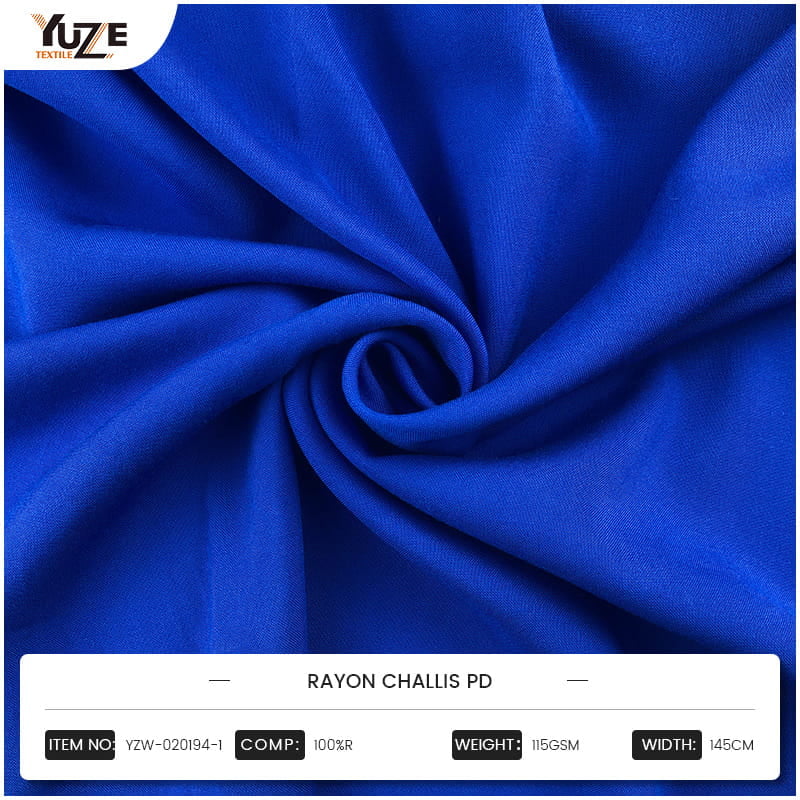 Rayon Challis Printed Fabric for Flowing GarmentsA lightweight 115 GSM 100% rayon challis with fluid drape and vivid print clarity, well suited for dresses, blouses, and skirts requiring softness and color brilliance.View Product →
Rayon, also known as viscose, is a regenerated cellulosic fiber that combines the softness and absorbency of natural fibers with excellent drape and color brilliance. Rayon challis is one of the most popular woven fabrics for women’s dresses, blouses, and skirts; it has a smooth, fluid hand, a gentle luster, and it takes printed patterns with exceptional clarity and vividness. Rayon poplin gives a more structured version of rayon with a clean, matte surface that works well for shirts and lightweight jackets. Rayon twill and slub weaves add texture and a casual, linen-like character. The main caution with rayon is that it can shrink and lose strength when wet, so it should be washed gently or dry-cleaned, and it benefits from pre-shrinking during finishing.
Polyester woven fabric
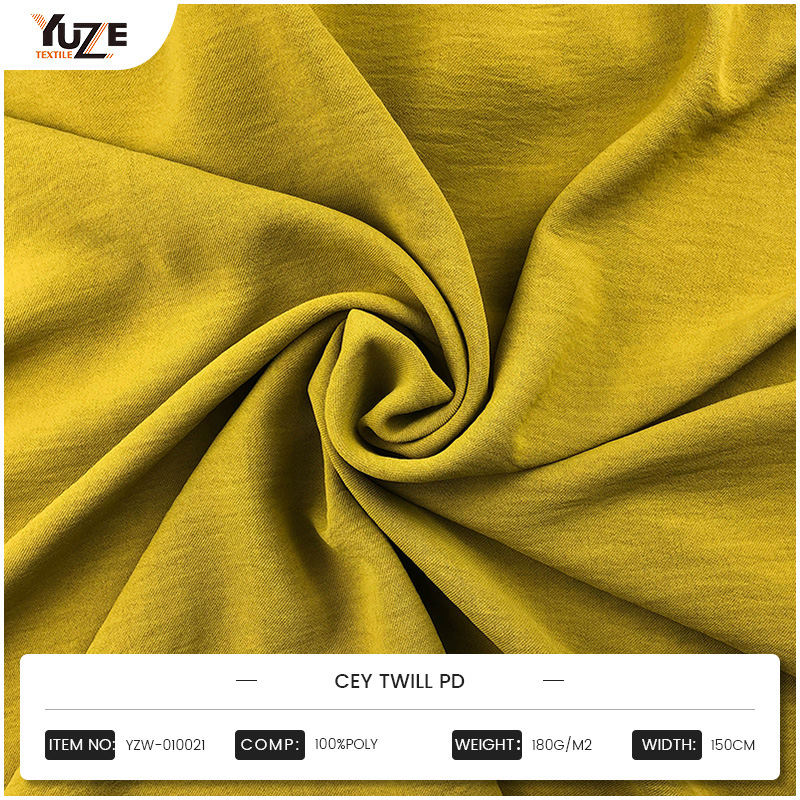 Polyester CEY Twill Fabric with Brushed FinishA durable 180 g/m² 100% polyester twill with a soft, peach-like surface, combining twill structure and wrinkle resistance for versatile jackets, trousers, and casual dresses.View Product →
Polyester is the workhorse of the modern textile industry. It is strong, durable, wrinkle-resistant, quick-drying, and holds color extremely well. Woven polyester fabrics range from lightweight chiffons and satins to sturdy twills and technical outerwear shells. A polyester twill such as the CEY twill combines the structural advantages of twill construction with a soft, brushed or peach-like finish, giving garment makers a versatile cloth for jackets, trousers, and casual dresses. Satin-weave polyester delivers high luster and a smooth hand at a fraction of the cost of silk, making it a popular choice for evening wear and linings. Polyester also blends well with cotton, rayon, spandex, and wool, improving durability and reducing wrinkles while maintaining comfort.
Linen and linen-look woven fabrics
Linen is prized for its crisp hand, natural luster, and exceptional breathability in hot weather. It wrinkles easily, and that wrinkle is part of its aesthetic appeal in summer clothing. Because pure linen can be expensive and tends to crease heavily, many manufacturers offer linen-look rayon or linen blends that reproduce the slubby texture and matte surface of linen with better drape and easier care. These fabrics are widely used for shirts, dresses, and lightweight suits in spring and summer collections.
Wool and wool-blend woven fabrics
Wool wovens are the foundation of tailoring. Wool suiting, tweed, flannel, and gabardine provide warmth, resilience, and a natural recovery from wrinkles that no synthetic fiber fully matches. Wool also absorbs moisture vapor, making it comfortable in both cool and moderately warm conditions. For cost-sensitive programs, wool is often blended with polyester, rayon, or elastane to improve wrinkle resistance, stretch, and affordability while retaining the tailored appearance of pure wool.
Silk and silk-like woven fabrics
Silk remains the benchmark for luxury woven cloth. It is strong for its weight, has a subtle luster, and drapes with a fluidity that is difficult to imitate. Silk charmeuse, silk chiffon, and silk crepe de chine are classics for blouses, dresses, ties, and scarves. Because silk is costly and demands careful handling, silk-like polyester satins and chiffons are common substitutes that provide similar aesthetics with easier care and lower price. When sourcing these alternatives, check the weight, finish, and drape carefully, because low-quality polyester satin can feel stiff and plasticky compared with a well-finished version.
Properties and Performance of Woven Cloth
The performance of a woven fabric comes from the combination of its construction and its fiber. A few properties matter more than others in real-world use, and knowing how to evaluate them helps you avoid costly mistakes in product development.
- Dimensional stability. Woven fabrics hold their shape because the warp and weft yarns lock each other in place. A well-made woven shirt or jacket will not sag, bag, or distort the way a loose knit can. However, cotton and rayon wovens can shrink if they are not pre-shrunk, so shrinkage testing is essential before bulk production.
- Strength and tear resistance. Twill and plain weaves with dense yarn spacing generally resist tearing and abrasion well. Satin weaves with long floats are more vulnerable to snagging. The fiber also matters: polyester and nylon are inherently strong, while rayon and some cotton yarns lose strength when wet.
- Breathability and moisture management. Natural fibers such as cotton, linen, and wool allow air to pass through the weave and absorb moisture, keeping the wearer comfortable. Polyester is less absorbent but can be engineered with wicking finishes for activewear. The density of the weave also affects breathability: a tight poplin is less airy than an open voile or gauze.
- Wrinkle behavior. Woven fabrics crease when the yarns are bent and held in position. Polyester and wool recover from creasing well; cotton, linen, and rayon tend to hold wrinkles. Wrinkle-resistant resin finishes can be applied to cotton and rayon wovens to improve recovery, though they may reduce absorbency and softness.
- Printability. The smooth, stable surface of woven cloth makes it an excellent substrate for printing. Digital printing is particularly effective on rayon poplin, satin, and polyester twill because the inks penetrate evenly and produce sharp, vivid patterns. The woven structure does not distort during printing, which is especially important for large-scale repeats and fine details.
- Finishing versatility. Woven fabrics can be transformed through a wide range of post-process treatments. Embroidery adds dimension and a handcrafted feel; foil stamping creates metallic accents; flocking produces velvet-like raised patterns; embossing imparts textures; and bonding laminates a second layer for structure or weather resistance. Because woven cloth is stable, it tolerates these mechanical and chemical processes without losing its shape.
These properties explain why woven fabrics remain the default choice for so many categories. They are strong, predictable, easy to cut and sew, and capable of a far wider range of surface treatments than knitted cloth. If you want to understand the production-side reasons behind this dominance, the advantages of woven fabrics over other textiles are worth reading in detail.
How to Choose the Right Woven Fabric for Your Garments
Choosing a woven fabric is a matter of matching the cloth’s weight, drape, fiber, and finish to the requirements of the garment. A fabric that works beautifully for a floaty boho dress will be wrong for a structured blazer, and a sturdy twill that makes great workwear will feel stiff and heavy in a summer blouse. Here is a practical guide organized by garment category.
Shirts and blouses
For men’s dress shirts, cotton poplin and cotton twill are the classic choices: they are crisp, breathable, and hold a clean line under a suit jacket. For women’s blouses, rayon challis and rayon poplin add drape and color depth, while polyester-based crepes and twills offer wrinkle resistance for travel and workwear. Pay attention to the fabric weight; a standard shirting ranges from 100 to 140 grams per square meter (GSM), with lighter weights for summer and heavier weights for winter or more structured fits.
Dresses and skirts
Dresses need a fabric that drapes well and follows the movement of the body. Rayon challis is a dependable choice for everyday dresses and maxi styles because it is soft, fluid, and prints beautifully. Crepe fabrics made from polyester, rayon, or blends add a textured, elegant surface that conceals minor figure irregularities and gives a professional finish. Satin-weave fabrics bring luster and a dressy look for evening wear, while cotton sateen offers a soft, slightly glossy hand for casual and semi-formal dresses.
Trousers and shorts
Trousers require a fabric with enough structure to hold a crease, sufficient durability for friction at the knees and seat, and a comfortable amount of give in motion. Twill fabrics in cotton, polyester blends, or stretch versions are the best all-round choice. Bengaline, with its subtle crosswise rib, is popular for women’s trousers because it is firm, dressy, and holds its shape. Stretch wovens containing spandex are now standard in many trouser programs because they move with the body and recover without bagging.
Outerwear and jackets
Jackets and coats demand heavier, more structured woven fabrics such as twill, gabardine, coated cotton, and wool blends. A polyester twill with a soft or peach finish is a common choice for casual blazers and light jackets because it combines a tailored appearance with easy care and moderate cost. For functional outerwear, bonded woven fabrics that laminate a second layer to the face cloth add wind resistance and body, making the garment feel more substantial without excessive weight.
Home textiles and accessories
Woven fabrics are equally important outside apparel. Flannel and brushed cotton wovens are used for bedding and loungewear because of their soft, warm surface. Heavier plain and twill weaves serve as upholstery and curtain fabrics, where stability and abrasion resistance are critical. Accessories such as scarves, ties, and bags rely on the crisp edges and print clarity that woven construction provides. In every category, the same rule applies: match the fabric weight and structure to the demands of the end use, and verify performance through testing before bulk production.
| Garment category | Recommended weaves | Recommended fibers | Typical weight range |
|---|---|---|---|
| Dress shirts | Plain, twill | Cotton, cotton blends | 100 – 140 GSM |
| Blouses | Plain, crepe, satin | Rayon, polyester, blends | 80 – 130 GSM |
| Dresses | Crepe, challis, satin | Rayon, polyester, silk-like blends | 90 – 160 GSM |
| Trousers | Twill, bengaline, stretch twill | Cotton, polyester, stretch blends | 180 – 260 GSM |
| Jackets and coats | Twill, gabardine, bonded | Polyester, wool blends, cotton | 220 – 350 GSM |
Quality Considerations When Buying Woven Fabric
Price and appearance are only the starting point when buying woven fabric. The true quality of a cloth reveals itself during cutting, sewing, washing, and wear. Experienced buyers check a set of well-defined parameters before approving a fabric for bulk production.
Thread count and yarn count
Thread count, usually expressed as the number of warp and weft yarns per inch, is a visible indicator of fabric density. A higher thread count generally means a finer, smoother, and more durable fabric, but only when the yarn quality is also high. A fabric made from coarse, irregular yarns with a high thread count can feel hard and board-like. Yarn count, expressed in the Ne system for cotton and rayon, describes how fine the yarn is; a 40s or 50s yarn produces a light, soft shirting, while a 20s or 30s yarn is more substantial. The right combination of yarn count and thread count depends on the desired weight and hand.
Fabric weight and GSM
Weight is measured in grams per square meter (GSM) and is the most fundamental specification for a woven fabric. A versatile rayon challis for dresses is usually around 100 to 120 GSM; a shirting poplin may be 110 to 140 GSM; a trouser twill ranges from 200 to 260 GSM. Always request the actual GSM from the supplier and verify it, because a fabric that is 10 to 20 grams lighter than specified can change the way a garment hangs and performs. GSM is also the basis for costing, so accuracy protects both the buyer and the supplier.
Finishing quality and color consistency
The finishing stage determines the final hand feel, luster, shrinkage level, and performance of the fabric. Check for uniformity of shade across the roll and between rolls in the same dye lot, because piece-to-piece variation is one of the most common quality complaints in the industry. Digital printing should have sharp edges and full color penetration without white spots or bleeding. Brushed or sanded finishes should feel even and not expose the underlying weave excessively. Verify that shrinkage meets your target, typically no more than 3 to 5 percent for apparel wovens, and that the fabric is free of odor or chemical residues.
Testing for durability and safety
Reputable manufacturers test their woven products for tensile strength, tear strength, seam slippage, pilling, colorfastness to washing and light, and crocking. For garments that will be washed frequently, colorfastness to wash and abrasion resistance are particularly important. Safety testing is equally necessary: apparel fabrics should comply with restrictions on formaldehyde, pH, and azo dyes, and they should not release harmful substances during wear. Many international buyers now require OEKO-TEX or comparable certifications, and a professional exporter will be able to document compliance.
How to Care for Woven Fabrics
Care instructions have a direct impact on how a woven garment looks after repeated use and washing. Different fibers and finishes demand different handling, and the care label should always be the first reference. As a general rule, cotton and linen wovens can tolerate warm machine washing, but they should be dried flat or at low temperature to limit shrinkage and wrinkling. Rayon wovens are more delicate; wash them cold on a gentle cycle or dry-clean them, because wet rayon loses strength and can distort. Polyester wovens are the easiest to care for, resisting wrinkles and drying quickly, but high heat should be avoided because it can cause permanent glazing or melting of the fiber surface.
Ironing knitted fabrics is rarely necessary, but woven fabrics often benefit from steam pressing to restore a crisp finish. Use the temperature setting recommended for the fiber, and iron on the wrong side for satin or printed surfaces to avoid shine or ink transfer. With proper care, a well-constructed woven garment can outlast many knit garments of the same fiber, because the interlaced structure resists the pilling and stretching that eventually ruin loosely built cloth.
Sourcing Woven Fabric from a Professional Manufacturer
For fashion brands, importers, and garment manufacturers, the choice of supplier determines the consistency, cost, and reliability of the entire production chain. Working directly with a professional woven fabric manufacturer and exporter has significant advantages over buying through a trading intermediary. A manufacturer that controls weaving, dyeing, printing, and finishing in-house can respond quickly to technical questions, maintain consistent quality across batches, and offer customized development based on your own design or their existing library.
Several capabilities separate a reliable woven fabric supplier from a simple trader. First, design resources matter: a supplier with an in-house design team and a large library of developed fabrics can reduce your sampling time and provide fresh options for each season. Second, sample service matters: professional suppliers offer free samples and analysis so you can evaluate the hand, drape, and color accuracy before committing to bulk production. Third, quality control matters: a serious manufacturer inspects every roll against strict standards before packing and shipping. Fourth, transparency matters: ask for actual GSM, shrinkage test results, colorfastness ratings, and lead times in writing.
Location also plays a practical role in textile sourcing. A manufacturer based in Shaoxing, near the China Textile City, benefits from an exceptionally complete supply chain, with yarn suppliers, dye houses, printing studios, and finishing plants all within a short distance. That industrial cluster shortens development cycles, makes it easier to source specialty yarns and chemicals, and keeps production costs under control while maintaining flexibility for custom orders. When you combine these advantages with clear communication and a supplier who understands your market, the result is a dependable partnership that protects your program from quality surprises and delivery delays.
Woven fabric is far more than a basic type of cloth; it is the most versatile and technically mature textile construction in human history. Its interlaced structure delivers the stability, strength, and dimensional control that garments need to hold their shape and perform their function, while the endless combinations of fibers, weaves, weights, and finishes make woven cloth the starting point for nearly every category of fashion and home textile. A cotton poplin shirt, a rayon challis dress, a polyester twill jacket, and a brushed flannel shirt are all products of the same fundamental technology, adapted by skilled manufacturers to serve completely different purposes.
Choosing the right woven fabric is ultimately a matter of matching structure and fiber to the demands of the garment, then verifying that the fabric meets your quality and performance standards through careful specification and testing. When you work with a supplier that understands weaving from yarn to finished cloth, you gain more than a product; you gain the ability to develop fabrics that are truly suited to your market. Start with a clear specification, ask for samples and data, and build your collection on fabrics that have been made, tested, and finished by people who care about the details.



.jpg)
